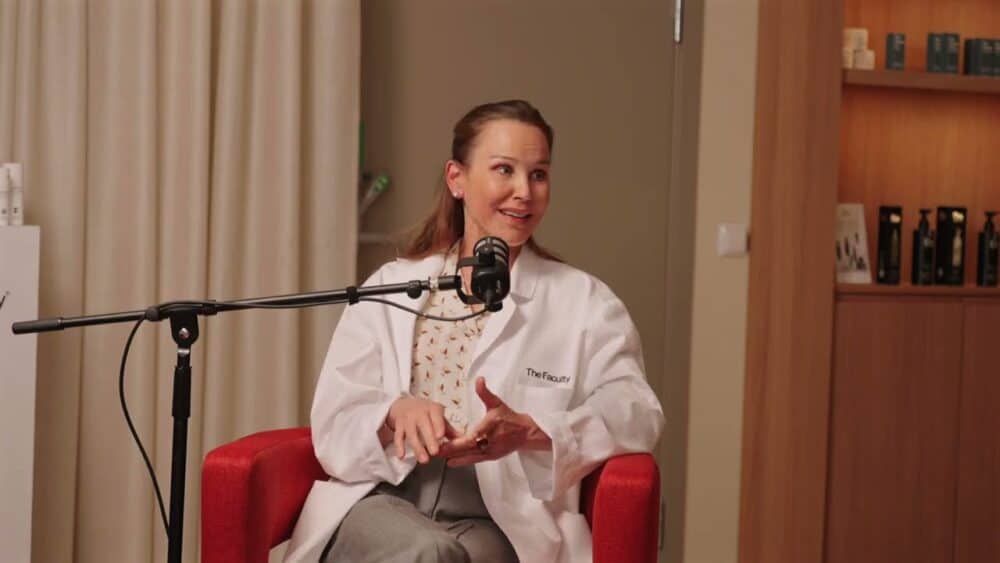
Breast surgery – Are the same implants suitable for everyone?
Why isn’t the same implant suitable for everyone? Per Hedén, Jonas Röjdmark and Riikka Veltheim discuss implant selection, shapes, surfaces and the questions you should ask before breast surgery.
Watch on YouTube
Related treatments: Breast implants
Do you just want to listen?Play the episode as an audio file – the text below will still be displayed.
Chapter
Transcription
Click on a time to jump to that point in the video. The text will follow as the section plays.
00:02 Welcome to The Faculty podcast. Plastic surgery, cosmetic treatments, beauty ideals. A multi-billion industry that everyone has an opinion on but few truly understand. Here, we peel back the façade and delve straight into the reality behind one of the world’s most talked-about and controversial industries. In today’s episode, we tackle one of the most common and most misunderstood areas of plastic surgery: breast surgery.
00:31 Why isn’t the same implant suitable for everyone? What determines whether the result will be natural, long-lasting and tailored to the individual? And what questions should you actually ask before making a decision about breast surgery? Together with Associate Professor Per Hedén and plastic surgeons Dr Jonas Röjdmark and Dr Riikka Veltheim, we’ll be covering everything from choosing implants to expectations, risks and results that stand the test of time. This is The Faculty Podcast.
01:02 My name is Per Hedén and I have more than 40 years’ experience in plastic surgery. I’m actually a very, very curious person, always interested in new developments, and that’s something that has guided me throughout my life. I’m always interested in new things. But at the same time, I take a critical, scientific approach to the innovations that are presented.
01:40 I’ve seen this sector evolve from being something people spoke about very quietly to something we talk about a great deal from the public’s perspective. And I actually think it’s fair to say that this speciality – plastic surgery – is something that interests the vast majority of people. People either have views along the lines of ‘I wouldn’t want to do that’ or ‘you shouldn’t do that’, right up to the point where they say, ‘I really want this to become more widely accepted’.
02:21 And I’ve been to dinners where people have talked about this. But I know that, during those dinner gatherings, perhaps two, three or four people have had plastic surgery, but nobody can tell. And the perfect procedure is, of course, the one you can’t see unless you know what the person looked like before. After all, what’s the point of a procedure that can’t be seen if it doesn’t result in a noticeable change? I’ve seen trends come and go, and I’ve been both challenged and inspired a great deal over the years.
03:09 I have performed surgery in almost every continent, and I am fascinated by what this speciality can do in terms of quality of life for so many people. So today we’re going to talk about breast surgery. It is, after all, the most common procedure in aesthetic plastic surgery. And I’m joined here today by Jonas Röjdmark.
03:37 Exactly. And Riikka Veltheim, who also works at The Faculty. And I thought we’d start by talking about the volume of breast implants. Breast surgery covers so many procedures, after all. There are reductions, lifts, augmentations and so on. But what’s on everyone’s lips is implant surgery. And I’ve been fascinated by how focused people are on volume when it comes to implants, even though it’s actually about dimensions. What do you think about that, Jonas? No, I, I…
04:24 I feel exactly the same as you. I’ve been practising plastic surgery for over 30 years now, and I’ve seen a great many breast patients over the years. I think that, before I answer your question, it’s important to first get to know the patient standing in front of me and ask the questions that probe: ‘What do you know about this? How do you feel about it?’ ‘Well, perhaps I think my breasts are too small, or they’re sagging, or whatever the issue might be.’ And that, after a period of discussion – before even examining the patient – this opens the way for questions specifically concerning
05:10 what you want the result to look like. And to work that out, well, perhaps the patient will say what I usually want to hear. I want a natural-looking bust. Exactly, exactly as Per was saying – something that isn’t really noticeable but which boosts my self-confidence. I mean, it’s something you do to feel better, to have this operation. And that’s when I usually say that perhaps volume isn’t the first thing on my mind; rather, I’m thinking more about the patient’s anatomy. What does the patient look like? And by then, quite some time has passed. We’ve discussed this procedure. We’ve gone into some depth
05:59 Before the patient goes over to the mirror and shows us what’s important. And then, based on that person’s individual circumstances, we can work out what might suit them best. And with a tape measure. How wide are your breasts, actually? Well, you’re 12 cm. In that case, you can’t have an implant that’s 14 cm, because that simply won’t work. But if your friend, who has a completely different bust width, has a volume of 500 cc and you have half that width, well, then you’ll look very different compared to your friend because you have completely different body types. So I think that’s a very important consideration.
06:48 to make some headway in the discussion with this person, to build trust before getting into the specifics of exactly how large the breast implants should be. Mm. And I do think what you’re saying is very clear, but it’s surprising that plastic surgeons – and indeed patients – actually focus so much on the question of volume. In one of my lectures, I have two patients standing next to each other. One is 2 metres tall, or just over 2 metres, and the other is 150 tall. And I’ve worked out that with
07:37 If we look at the chest circumference of these different people, the taller, larger person would need to have three times the volume of the smaller one to appear exactly the same size. What do you think, Riikka? But it’s all about the individual you’re treating, and that’s where we’re specialised and trained – to tailor the best possible outcome to that patient. And we’re all different. We have different shoe sizes, different hands. And the same goes for breasts, of course.
08:14 And then, just as Jonas says, we have to try to understand what that particular person wants and what they like, what their tastes are, and what they think of. And then, of course, it’s our knowledge that enables us to get as close as possible – hopefully – to the measurements specific to that patient. So ultimately, when it comes to volume, that’s actually the least important factor. Just as you say, Per, we have to guide the patient. That’s what it’s all about. The patient may not know very much about breast implants, this type of surgery and so on. And so it’s up to us, as the experts in this field, to be able to explain – starting by listening, and then... and then...
09:01 So you have to discuss it with this person to work out what might be appropriate. Because sometimes you might be asked, ‘Well, what do you think? What do I think? Well, I can think many things,’ I said. ‘You can, but I’ll base it on your measurements, and then you’ll need to have a say in this too. Then you can arrive at things like trying out different cup sizes in a bra – little things like that – to help the patient, or the person in question – you, the viewer – to better understand what we’re discussing. Because, at the end of the day, it’s you who’s going to have to live with this. It’s not me who’s going to have to live with it. But I must – I must be able to guide you in the right direction.
09:47 So you think that this thing I did – it was good for me. I feel good about having done this. That’s how I feel, and I think that’s important. I’ve been surprised by how many plastic surgeons actually suggest a volume without taking any measurements. Mm. It’s a bit old-school. Old-school. Yes, 3 dcl will be fine. Where do you get that from? Well, you start by measuring the patient and assessing their circumstances. Then you can suggest, ‘Well, bearing in mind what you want and what you’re hoping for, this might be the right option for you.’ But then, would this patient, who trusts this
10:37 Would a surgeon trust a tailor who doesn’t take measurements? I mean, come back next week and I’ll have your wedding dress ready. But aren’t you going to measure my arm? No, no, I can see what you need. Or a joiner who can say, ‘I’ll make a shelf there’ without taking any measurements. I’ll just saw this bit to size.’ They’d never trust that. But they do trust plastic surgeons who don’t take accurate measurements.
11:06 Absolutely. I also think there’s a very important dialogue between the expertise we have and the patient. Because often, as you say, Jonas, the patient might say, ‘I want something’, whilst we have our own ideas. But then perhaps a suggested image can provide a bit of guidance. What looks natural? What’s best for the person we’re seeing? Because it might be close to what we imagine, or it might be quite far off. And that’s why this discussion, this dialogue, and trying out implants – just as you say – is like standing in front of the mirror wearing your favourite jumper, with the precisely measured implants that fit. And then you really get a much better sense of what’s going on.
11:55 in your body. Yes, during my consultations I usually take measurements to work out what’s best for each patient. You have to understand that there are several factors that determine this. There’s the width of the chest, as you say. There’s the height of the nipple. There’s the amount of skin over the lower pole. Because if you have very tight skin, you can’t have just any size of implant. And similarly, if you have a lot of loose skin and a bit of sagging, then you might need a larger implant. But once I’ve set a limit – say, you can have a breast width of perhaps 12.5 to 13 cm – and
12:45 Then you might have a low or moderate protrusion. In that case, these are the limits that apply. We do, of course, discuss with patients what the outer and lower limits are for an implant. But then I usually recommend that they speak to our nurse, and I think you do the same. Nurse Tina here is very experienced in using a 3D scanner, where you can see on a screen what the possible result might look like. You get a visualisation of it, and then they try it out with a sizer to make sure they’re comfortable with it.
13:26 Yes, it’s really nice because then you get to see your own body on a computer screen and see what happens when I have this breast size. And I think that might bring you even closer to it. Yes, this is what I want today. Or that wasn’t what I had in mind at all. In that case, we’ll have to backtrack and look at other sizes and shapes. I think one thing you mentioned, Per, is incredibly important too – the point you’ve just raised here. It’s the quality of the skin, or the quality of the breasts themselves. There are, of course, young women who have very firm chests or small breasts. That patient is, of course, not the same as someone like this who has lost 50 kg and has skin that’s more or less like chewing gum. A completely different type of procedure is required for those people. You can
14:16 I wonder whether this patient will even be able to manage with just a breast augmentation using an implant? It might be necessary to perform a lift at the same time to tighten the tissues. And although this is the sort of person who has that sort of problem – I’d say with their skin – they must be given clear information that if they choose a large and heavy implant, they risk their breasts becoming stretched quite quickly.
14:46 So you run the risk of coming back after a relatively short time and saying that you’re not satisfied, but that you want it tightened even more – even though the surgeon may have tightened it as much as he or she possibly could during the operation itself. So the condition of the skin on the breasts is an incredibly important thing to explain to the person concerned – or to you, the listener. So I look at each person and listen to them. I ask them to take off their shirt so I can take measurements. Then you have to feel the breasts – how they function, what they look like, what they’ve actually been through in life – so that you can achieve a relatively lasting result, so that the patient doesn’t come back after six months feeling that it wasn’t a good result, the breasts start to sag again or something like that.
15:33 Exactly. And it’s important to realise that you can’t compare yourself to a neighbour or a friend, or even your own sister. Because we lead different lives. We have different genetics. We have different starting points; we’re different heights. We’ve breastfed different numbers of children, and perhaps had different weights at different stages of our lives. So the fact that my neighbour or my sister is a certain way has nothing to do with your own starting point – we have to look at you. And just as we talked about earlier, yes, I had a friend who had 3 dl implants.
16:09 I usually say yes, but how large was her chest? What was her chest circumference and so on, so that people understand it’s the dimensions that matter. Exactly. And at the same time, one could say that it’s also important for patients to understand that plastic surgery cannot promise results accurate to the millimetre.
16:34 So that’s a general finding, then. And as you say, if you end up with very large breasts, the tissues are affected more. Mm. Smaller breasts are less affected by the implant. Mm. Absolutely. But as I said, it’s important to understand that I usually draw this normal distribution curve, which applies to everything in biology.
17:10 So, the normal distribution curve applies to one extreme, where there are very, very short individuals, for example. The other extreme is very tall individuals. At one extreme, there are very small breasts. Mm. The other extreme is huge breasts. Everything biological follows a normal distribution curve. It’s not always the case that people fit this pattern; even though the average height for women in Sweden is perhaps 169 and for men 179, it doesn’t mean everyone falls within that range. You have to expect a spread in the results. Mm. And it’s absolutely vital that they understand that plastic surgery doesn’t produce results that are accurate to the millimetre, and I
18:00 I always emphasise to my patients that the breast should have a nipple situated right in the centre of the breast. Absolutely. What about different implant surfaces, then? Because there are, of course, a wide variety of implant surfaces – do you discuss this with your patients, Riikka? Well, we don’t start with that, but of course we do discuss the risks of capsular contracture and where it might occur. Thankfully, these days it’s very rare – as we know from the old days when we were performing surgery 20 years ago, so
18:46 We saw a much greater incidence of capsular contracture in response to implants. But then, of course, our expertise is crucial in choosing the right type of surface, as this is almost as important as the shape, width and size when it comes to the durability of the breast we create, particularly if the skin is thin. Just as you say, Jonas, if a patient has lost a lot of weight, perhaps a certain type of smooth, slippery surface isn’t the best option; instead, we need a surface that grips firmly. And, of course, it’s very difficult for the average person to make that decision – that’s where our expertise comes in. And
19:32 Ultimately, you should be made aware of the pros and cons. But I believe that for a patient with very delicate skin, it would be completely wrong to choose an implant with a smooth, slippery surface – which might be perfectly fine or even good for a young person or someone who is afraid of certain risks, which are few and far between.
19:58 Yes, that’s right. Jonas is now showing us a few different implants here. Mm. Well, I usually put it like this: as both my colleagues know, there’s been a real revolution in the field of breast implants, and over the years that he’s been working in this area and attending conferences all over the world, he’s found that the implants of that era are usually marketed the implants of the time as the very best, with no problems whatsoever. But there’s been quite a history surrounding implants. As for the early implants, they were more or less silicone implants filled with liquid silicone. The
20:46 That type of implant was used in, well, the 80s and 90s, and very frequently, I’d say. And even in the 60s. Yes, even in the 60s. Yes. And in the 70s – well, I’d barely been born then. [laughter] The 70s. Yes. No, but – and I think it’s very important, too, when patients come in or when you’re seeing them, to try and get a bit of a history. Yes, there are these types of implants. Here you have a liquid silicone implant. If I cut into it, well, then it’ll leak – a lot of silicone will leak out into your tissues. And it’s a bit of a nightmare for a surgeon to remove that silicone later on, especially if the breast has become rock-hard and encapsulated.
21:31 What’s more, as Riikka said, there is a risk with patients who have thin skin that you might get something known as ‘rippling’. In other words, if you lift the implant, you can see these ridges in the implant itself, and they can be visible through the skin. So then you come back and think, ‘Well, that didn’t look very nice.’ What I’m trying to say here is that, just as with cars, implants are constantly improving – they’re getting better and better, and they have increasingly better surfaces. And eventually, we’ll have slightly more robust implants with double shells – that is, a lubricating layer and an inner core of stable silicone. So if you cut into it, it works much like
22:18 A jelly-like implant. Nothing leaks out, so in my view, at least, you end up with an implant that carries significantly fewer risks. And over time, implants have also been developed that are lighter than others and which have less of an impact on the tissues we’re talking about. So this market is constantly evolving towards better and better implants. But I’d like to say that, for as long as Per and I have been working on this – and Riikka too – people have always been saying, ‘We now have this, it’s the best implant; this is the best implant; this is the best implant’. I’m sure that as my career continues, there won’t be a single ‘best’ implant; there will always be something
23:04 which, unfortunately, has a slightly negative aspect to it, because what you’re putting into your body isn’t entirely natural. But you can minimise the risks, and I think that’s what the developments in various implants are all about. Yes, a bit like everything in life, there are pros and cons. And given that we have all these options with different implants, it’s once again down to our expertise to find the absolute best solution for the individual who comes to us. Nothing is 100 per cent optimal in any aspect of life, but we can try to put as many things as possible in the ‘positives’ basket. And that’s why I also think that for us as surgeons, it’s fantastic to be able to tailor the treatment, pick and choose, and say, ‘This and this are important specifically for you.’ That
23:52 That’s why people come to see a specialist. Yes. And I do feel that in the past – and I’ve been practising in this speciality for quite some time – it used to be easier to carry out a breast consultation for a patient, as the options were far more limited. Now, patients should be informed that there are different implant surfaces, each with their own advantages and disadvantages. There are different shapes of implants – both round and anatomical – and there are now lightweight implants, which are 30 per cent lighter.
24:41 And on the downside, there are also different types of gel. So I think a breast consultation these days takes much longer than it did 20 years ago. That’s absolutely right. Well, what do you think about the shape of the implants then? Well, we’ve got the standard, traditional round implants, which have been around the longest, and then we’ve got the anatomical, so-called teardrop-shaped ones. And again, ultimately, what people prefer comes down to personal taste, and it also depends a lot on your starting point – as you mentioned, those with what’s known as a very ‘short’ bust under…
25:28 the nipple. It may well be that a round implant doesn’t give the best possible shape. No. Just because it’s a round implant – and that’s something you have to bear in mind. There are studies showing that for a natural breast to look natural – or for it to appear natural – 55 % of the breast’s volume should be in the lower pole. Not 55 % in the upper pole, because then the nipples will point downwards. And well-controlled studies have been carried out on this by our colleague Mallucci in London.
26:05 And that is a well-established principle. A round implant has more volume in the upper part, whereas an anatomical teardrop-shaped implant has more volume in the lower pole. This means, of course, that a round implant needs to be placed further down. And there, one must take into account the position of the crease beneath the breast; if the crease is well-defined, there may be a risk of a double contour. This may need to be addressed using fat grafting. Fat grafting involves hybrid procedures where fat is combined with implants. In such cases, one must assess the risk of contour irregularities in the lower pole. But
26:54 As I said, once again, breast surgery is far more complex than it has ever been, and I don’t think patients – perhaps not even our colleagues – fully understand just how many different aspects there are to it. Exactly. I think we’re a bit blind to it, given that we’ve had the chance to work with you, Per, who’ve developed this breast technique – the Faculty technique – where you measure the breast in a very specific way. For us, it’s part of our daily routine and we’ve been doing it for years, but for anyone outside this team – and for the patient – it’s obviously not information that’s easy to grasp.
27:38 But I believe that the technology and techniques available, and the maths – the mathematical scale – that you have developed, also give us a real sense of security and help us get it right. Yes, I’ve even developed a little app – a breast augmentation app – which is available for surgeons to download, and it’s been downloaded 8,000 times worldwide to date; it helps doctors choose implants and take precise measurements. We’re also going to talk about other breast surgeries, such as reduction and lift procedures. And that’s, well, that’s more…
28:27 standardised. And you can even combine that with an implant – you can even carry out a reduction-augmentation procedure. And it’s a bit, well, it’s a bit counter-intuitive to both reduce and enlarge. But there is a situation where you should actually do this more often than you do, and that’s in breast cancer reconstruction where one breast is large. You’ve reconstructed one breast with an implant, or a breast affected by cancer with an implant, and then you have the remaining breast on the other side which is large and sagging. And in that case, we know that it
29:15 The long-term results of simply performing a lift or reduction aren’t as good as if you insert an implant. Exactly. Because implant-enhanced breasts tend to age less. They sort of hold their shape better. Natural breasts tend to sag over the years. So, that’s the case, but I do think that reduction-augmentation procedures are an underused option. It’s a bit of a contradiction, I’d say, to both remove tissue and augment, and for those who have this natural
30:01 the volume and the sagging, just like your own tissue that droops. So you can replace some of your own tissue with an implant if you want a rounder or higher-set breast. Yes. When you perform a lift, what techniques are there for doing so? A lift often involves repositioning the nipple. Mm.
30:35 What techniques can be used, then? No, well, personally, I think it’s important – and I mean here too – to look at the elasticity of the patient’s tissues, and then, of course, you also measure the patient in front of the mirror and look at them, and you see, for example, that your nipple is positioned so many centimetres from where the neck ends. And then you look at both sides to see whether there’s symmetry or not. The idea behind all aesthetic plastic surgery, as well as reconstructive plastic surgery and breast surgery, is to create symmetry for the patient. Even though there may be different circumstances when it comes to a patient who has had
31:20 breast cancer and has no breast. But the idea is that the patient should stand in front of the mirror themselves and say, ‘This is where your nipple should be.’ And then, of course, we have different approaches; we’ve learnt from plastic surgeons about different templates for how large an areola should be. It can vary slightly in size from one patient to another. And I usually say to my patients, ‘Do you remember what the old Swedish five-krona coin looked like?’ Yes, they do. Well, that’s roughly the size I think is quite natural for an areola. Yes, well… What do you think? Well, I think it’s too big, or I think it’s too small. And even there, it’s a matter of getting a feel for it. Then, of course, you have to go through the technical aspects of how you plan to carry out the operation. And here too
32:06 There are, of course, various techniques. There used to be a technique called the Lejour method, which involved an incision around the areola and a vertical incision straight down, where the skin was gathered and pleated. It fell into disuse quite quickly because of the scarring it caused. In plastic surgery, it’s very important to be skilled at suturing and to learn how to suture in layers, as patients are very concerned about scarring, and there is much more scarring involved in a breast lift than in a standard breast augmentation, where you can get away with just a few centimetres of incision the inframammary fold. And then it’s also important to ensure that the nipple and areola have adequate blood circulation. You can
32:54 It’s not just a matter of cutting and moving it; you have to transfer it using what’s known as a vascular pedicle – or something as small as a little tongue, you might say – to ensure there’s blood flow to the areola and to create a tight fit so that the breast isn’t sitting down here but is held in place. Then, of course, we need to discuss whether the patient has very large and heavy breasts. Perhaps back pain. How big do you want your breasts to be? Yes. And then I say, ‘But what do you think?’ ‘Well, I think you should perhaps have…’ and then I demonstrate with my hands. ‘No, I don’t want that much left,’ they might say. ‘I want more removed.’ It’s all about communication, isn’t it?
33:36 Yes. And then, I think it’s also a matter of explaining to a patient why a procedure they’ve heard of might not be suitable for them, given the type of breast tissue they have. But I once had a patient from the Eastern Bloc who had told the surgeon, ‘I don’t want any scars on my breast.’ Well, in that case, we’ll insert the implant – as was done in this instance – via the armpit.
34:07 And he didn’t take into account that this would lead to a really poor result. But the fact was that she’d made it clear she didn’t want any scars. But you have to explain why that won’t work. So she went to another surgeon and said, ‘I want as little scarring as possible on my breast.’ Well, in that case, we can lift the breast by cutting only around the nipple. And then she came to me and said, ‘But that won’t work unless you do an inverted incision.’ That is, you simply have the fold underneath the breast, and this is often the case with many patients: the breast fold is the fundamental starting point or basis for a breast augmentation in
34:58 In many, many cases. Then, in some cases, you can perform a periareolar procedure – that is, around the nipple – or a vertical procedure. But this is based on the measurements, and although there may be more scarring if you do it this way, the scars are very fine when the procedure is carried out properly. Even if there is more scarring when you achieve a better shape, it does, of course, look better aesthetically.
35:26 Yes. And I’d say this: you have to be clear about your priorities. When it comes to an operation, the first priority is safety; the second is the shape of the breast. Thirdly, the third priority is the appearance of the scar – making sure the scar is stitched up very carefully. And the fourth priority is the length of the scar. It’s just that people, even doctors, sometimes get that order the other way round. Yes, but you should make it as short as possible there. No, but that doesn’t work with the shape.
36:06 No. Yes, exactly. So doctors need to have their priorities clear. Information. Information. And that’s, of course, what applies to an incredible number of different things we do in plastic surgery. You have to make sure the patient understands what we can do and what we can’t do. And you have to be very honest about the limitations of a procedure, the drawbacks, the risks and so on. You should help patients understand that, well, I don’t see any need to operate on you. I see
36:54 that you have a reason to do this, but it’s up to you whether you do it or not. So the communication process is absolutely vital, and I think we all agree on that, don’t we? Yes, well, I often find that when I’m having a discussion with someone who’s coming in for an operation – whatever it may be – I can sometimes say to you that this discussion, or the information we’re talking about now, is absolutely for your benefit, but it’s actually for my benefit too, because I need to get to know you and your brain and your wishes and your expectations, because ultimately, once I’ve started this
37:42 the operation – that’s when your expectations kick in, and they’ll be pinned back on me afterwards. If this doesn’t go well, if I haven’t informed you about these things, then it could lead to a situation where nobody ends up happy. And that’s also, to some extent, a matter of experience, I’d say – as a doctor, learning to get to know the person who’s going to undergo the operation, the one who’s facing it, if I want to perform this operation myself. That’s why it’s important to ask yourself: is this a suitable patient for me to operate on at all?
38:19 Yes, I think that’s absolutely crucial. Yes, as you say, you have to – you really must – refrain from operating on a patient who you don’t think will be happy with the outcome. No, no, that’s exactly how it is. Absolutely. That’s the hardest part of our job. Yes, one of the hardest. One of the hardest. [laughter] It’s not exactly an easy speciality we work in. No. No. Does this apply to breast surgery as well?
38:49 Is that something that’s subject to trends at the moment? People were saying that, yes, the trend is for a natural look, whereas before it was all about Pamela Andersson and really big hair. Has that changed a bit now? Or is it just that, in the public eye, there’s a trend towards wanting to look more natural?
39:20 I think that’s the way it’s going. There are trends, of course, and one of those trends – and the message to women – is that with breast augmentation, even though it’s called that, we can actually use very small implants for those who don’t want large breasts but want a more attractive shape, particularly for women who have breastfed and whose breasts have sagged. Even if you’ve always been used to having small breasts, are slim and fit, and have never wanted large breasts, you might not like the change in shape that life, weight loss or breastfeeding can cause. And in that case, there are other options. You don’t need to have a breast augmentation and, just as you said at the start, get a
40:07 huge volume and look like you’ve had surgery. But nowadays we can do without that, and we have fantastic implants available. We can actually change the shape – without altering the volume too much – so that it looks younger and firmer. So I think that’s fantastic information to share, and that people have started to realise that you can actually do things even if you… Yes. And it’s as we said, or as you mentioned, that there are so many different implants to choose from, and that means we can tailor the procedure to the patient’s wishes. I mean, I had a patient today who said, ‘No, I hadn’t really thought about breast implants,’ but when she realised that there are very low-projection implants,
40:55 So, a low projection that can give a very small volume even though there’s good width across the chest – she said yes, but perhaps it’s still right for me, yes, to give the breasts a more youthful appearance, to get firmer breasts exactly, and also this myth about old implants being hard still persists, and people areafraid that the breasts might feel hard or not move like natural breasts. I think the incredible developments that have taken place in recent years are fantastic – we now have implants that feel and look natural when you touch yourself in the shower or in your dressing gown, or when you’re hugging someone. So, as a woman, I think this is one of the most important
41:43 As for the changes in implant technology, I think they feel soft to the touch. No, but I do think – I absolutely believe – that the trend has moved from something that was worse to something that’s better. I mean, it wasn’t uncommon to see young girls who wanted a very, very large bust, wasn’t it? And the question is: why? Were they doing it for themselves, or were they doing it for a potential partner, or things like that? And these days, it feels as though most girls have greater self-confidence. I sometimes get the feeling that, like, ‘no, I’m not going to have breasts that are too big’. I’m doing this for myself. I’m not doing it for a potential sexual partner or because
42:32 I want this and that, but it’s just that… I think it’s nice that there’s a certain strength amongst women today where you feel, ‘No, but OK, I want – I want – I want to have a natural and attractive bust that I’m happy with myself, and if I’m happy with it, then you’ve got the right bloke’ then he’ll be happy with it too. I’m absolutely convinced of that. What makes for good cosmetic surgery?
43:02 Good cosmetic surgery is, of course, safe surgery. And as you say – and this is how I see it – I think it must look natural. I don’t think you should do anything if it looks artificial. But of course, it should make a difference. But it’s precisely this discreet, elegant, natural look that I think is the finest plastic surgery we can offer. Yes, I also think that the whole process for someone who comes to us is, in many cases – at least when it comes to aesthetic and even reconstructive plastic surgery – It’s really about the individual here – about improving their own quality of life.
43:44 I think it’s important that a surgical procedure should bring about something positive for the person undergoing it. And with the right information, the right technique and experience, you can make it look natural. If you succeed in that, then you’ve performed a good plastic surgery procedure. Mm. Yes, well, I think there’s a lot of truth in what you’re saying – that a good procedure looks natural, that you can’t tell it’s been operated on – and I think we should say no if patients want a very artificial and unnatural change.
44:34 Lips that are far too big, busts that are far too voluptuous, and so on. How many times do you say no, Riikka? I mean, what I try to rule out, just as we discussed earlier, is when I feel the information doesn’t match. We’re good at providing information, of course, but if you don’t feel you’re getting through in certain cases, I feel that people might have certain expectations or desires and end up with something we can’t provide. And even if we explain this, they don’t really want to let go of the idea that I can’t
45:19 I can’t look like I did 20 years ago, or I can’t look like my friend because she hasn’t lost 60 kg, or for various other reasons. So I think it’s very important to say now that I don’t think we’re on the same page, and that’s where I try to do my best and be prepared to improve, so that if it really does feel completely wrong, we don’t go ahead and make surgical plans. Mm. Are we good at saying no, Jonas?
45:56 I mean, I find I talk more the older I get with patients. And I suppose that’s partly down to experience as well. You’ve learnt from your own mistakes and recognise a certain behaviour – perhaps in a person, or in myself – that I know is very difficult to, sort of, get to grips with. Well, I simply can’t get there. I feel that I’d rather rein that person in before I get to that point. But then there’s another important issue: no matter how skilled you are as a plastic and aesthetic surgeon, complications do sometimes arise, and that’s where it’s so incredibly important – and I think this is one of the great things here at The Faculty – that we have a very good
46:42 opportunities to get in touch with people and staff at the clinic where you had your operation. No surgeon in the whole world has only happy and contented patients; sometimes we have to be prepared for the possibility that a patient might experience bleeding after an operation. It could be an infection; in breast surgery, for example, you might develop something called capsular contracture – in other words, hardening of the tissue. And in such cases, you need further help from someone who doesn’t just go and hide away, but who can deal with complications.
47:18 And as I said, as for this business of saying ‘no’ – well, it’s a feeling based on experience, I’d say, where you’ve yourself had to deal with that sort of patient before and then gone through a process that hasn’t always been positive. No, I agree with you – we should definitely say ‘no’ in situations where we feel that this patient has unrealistic expectations.
47:51 So what do we do when patients are dissatisfied? How do we deal with that? Well, that’s where we are at The Faculty – I think we’re very well equipped in that respect, as there are so many of us with extensive experience, and whilst we all know a great deal, we perhaps have slightly different specialisms and slightly different personalities; as with any human interaction, in some cases it might feel better to see someone else. And because there are so many of us with extensive experience, there’s always the option of meeting someone else and getting a different perspective from someone who’s looking at things with fresh eyes, and then, of course,
48:39 feel safe and be listened to and assessed without having to go to another clinic. Yes. Yes, and of course there are situations where either a condition presented at an initial consultation is difficult to assess – ‘How am I going to resolve this?’ – or a condition following an operation where I’ve realised, ‘I haven’t come across this problem before’. And in those cases, it’s really reassuring that we have clinic conferences where we discuss these challenging cases.
49:20 There aren’t many of us here, but it can be very reassuring for the patient to get a second opinion, and also for us as doctors to have that support. And as you say, that’s why we work in such a large organisation. And as you say, developments are constantly moving forward. That gives us the opportunity to take them on board and evaluate them. Is this something we want to work on? But we’re also open to what’s happening in the world, and that gives us the chance to adopt the things we genuinely believe will improve or make care safer for our patients. Yes. And we then have the ability to
50:08 to keep our colleagues informed about the latest developments we’ve heard about at a conference or a meeting – that this is an international trend, and so on. And that’s what enables us to maintain high standards in everything we do. Yes, you never stop learning, and that’s one of the things that’s so great about this specialism – that you can constantly develop yourself, and you can’t rest on your laurels, so to speak, and say, ‘I know everything’ or ‘I’m the leading expert’ – because there’s always
50:53 There are always new things you can learn and do to make things easier, both for yourself and for your patients. That’s what I appreciate. I really agree with you. I’ve seen how, earlier in my career, senior figures – clinic managers, people with a lot of experience and so on – would say ‘no, that’s not for me’ when we suggested new ideas. ‘I’ve been doing this for so long and it works fine.’ I’ve said to myself, if I say that, I’ll have to stop performing that operation [laughs], because the fact is, that’s what progress is all about, and that’s what makes it so incredibly enjoyable to work in this field – because of that progress.
51:42 It happens all the time, doesn’t it? Mm. I couldn’t agree more. Absolutely. It’s fantastic. And the whole idea that everyone is different. Every single patient is unique, from the way they think, but also in terms of the development we’re all going through – and being able to share the realisation that we don’t have to be pigeonholed and do things the same way, but that we’re allowed to grow. I think that’s the joy you feel almost every day when you come to work. Joy.
52:15 That is why we work at The Faculty. Here, we are optimally equipped with the latest techniques to carry out fat grafting – for example, to the breasts – using the most up-to-date knowledge regarding new implants. We also carry out a great deal of scientific research and have many colleagues with whom we can discuss matters.
52:43 That’s actually why The Faculty was set up. Yes. Do we have any closing remarks, then? Yes. Are you interested in breast surgery of any kind? If so, we promise to give you all the time you need and provide you with honest information based – just as Per Hedén said here – on science, where we assess the situation and, together with you, determine exactly what kind of operation is required and how it should be carried out to suit you specifically. And with that, we’ve perhaps come to the end of this episode of the podcast. We’ll continue
53:34 With this, you’ll be hearing a great deal more about plastic surgery. So do have another listen. Bye for now.