Most oxygen is bound to hemoglobin
When you breathe normal air, the red blood cells carry almost all the oxygen, and they are essentially full even at normal pressure. A small amount of oxygen is also dissolved in the blood plasma. 2
Curious about trying a hyperbaric chamber in Stockholm? With us at The Faculty you can book a session of 60 or 90 minutes, from 2,800 SEK. Before the first session you will receive a free consultation by phone, where we will go through your health declaration.
In a hyperbaric chamber, you breathe oxygen at a higher pressure than normal atmospheric pressure. This allows more oxygen to dissolve in the blood and reach tissues that otherwise have difficulty getting oxygen. The method has been used by healthcare professionals for over 60 years for a few well-defined conditions, from decompression sickness to difficult-to-heal wounds. 1, 3 In recent years, pressure chambers have also begun to be offered privately, for recovery and well-being, and there the research is considerably thinner. 9, 25, 27
On this page you can read how a passport works, how much it costs, what the research shows and what risks there are, so you know what to expect before you book.
Are you having surgery with us? Once your surgeon has given the go-ahead, you can book a session in the hyperbaric chamber. You can read what the research says about it below. pressure chamber after surgery.
The text is written by The Faculty and reviewed by Anders Kjellberg, chief physician and expert in hyperbaric medicine. Updated .
Until November 30th, you and a friend can try 90 minutes in our pressure chamber together. You pay 3,500 SEK for both of you, instead of the regular 4,500 SEK. Before the session, we will call you individually for a brief review of your health declaration, and the session will be booked as usual.
3,500 SEK
Ordinary price 4,500 SEK
for two people, 90 minutes
The promotional price is for a 90-minute session for two people who go to the chamber at the same time, completed by November 30th. The regular price is SEK 3,500 for the session and SEK 1,000 for a guest. The same health declaration and rules as for all sessions, see risks and side effects.
A hyperbaric chamber is a closed room where the air pressure is raised above normal. Inside the chamber, you breathe oxygen through a mask. The combination of high pressure and high oxygen content means that the blood absorbs much more oxygen than usual: not only that which is bound to the red blood cells, but also oxygen that dissolves directly in the blood plasma. The dissolved oxygen can reach tissues where blood flow is poor, such as a wound that does not want to heal or tissue damaged by radiation. 2, 3
The treatment has many names, and they mean the same thing. Healthcare professionals call it hyperbaric oxygen therapy or hyperbaric oxygen treatment, abbreviated HBO, or simply pressure chamber treatment. Internationally and in private clinics it is called HBOT, hyperbaric oxygen therapy, or HBOT treatment, and the chamber is called a hyperbaric chamber in English. Sometimes you also hear oxygen treatment, oxygen chamber or oxygen chamber. 1177 simply calls it pressure chamber treatment. 1, 3
Pressure is given in atmospheres, ATA, where 1 ATA is the usual air pressure at sea level. Hospitals use 2.8 ATA, equivalent to 18 meters below the surface of the water, for acute conditions such as decompression sickness, carbon monoxide poisoning and severe infections. For chronic conditions, such as non-healing wounds, 2.4 ATA is often used, and many centers have switched to 2.0. 1, 4, 30 Our chamber is pressurized to 2.0 ATA, equivalent to a depth of ten meters, and you breathe oxygen with a concentration of about 95 percent. You can find more about the differences between hospital chambers, ours, and home chambers under hospital, clinic or home room.
Oxygen can be a medicine. Medical oxygen, 100 percent, is approved by the Swedish Medical Products Agency, and the product information states that hyperbaric treatment, at pressures above 1.4 and a maximum of 3 atmospheres, should only be given by qualified healthcare professionals. 5 Your safety is always our top priority. That's why we follow the same procedures as for any medical treatment. Before your first session, you fill out a health declaration and have a phone call with us where we go through it. Trained staff are on site at each session.
At the same time, it is important for us to be clear: we do not treat diseases, and we do not claim that a session with us has the same medical effect as the hyperbaric oxygen therapy (HBOT) provided in healthcare, where there is scientific support for certain diagnoses.
At 3 ATA and pure oxygen, the dissolved oxygen in the plasma is in principle sufficient for the body's resting needs, which is the basis for treatment of severe anemia. 2, 5
The slideshow will play automatically. Scroll through it yourself using the arrows or by swiping.
When you breathe normal air, the red blood cells carry almost all the oxygen, and they are essentially full even at normal pressure. A small amount of oxygen is also dissolved in the blood plasma. 2
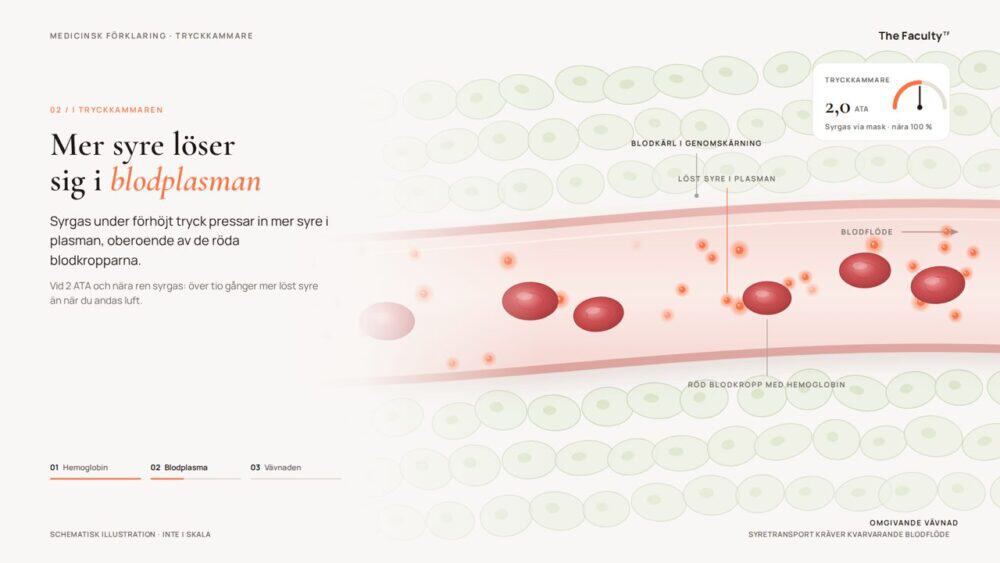
Oxygen under increased pressure forces more oxygen into the plasma, independent of the red blood cells. At 2.0 ATA and near pure oxygen, this is over ten times more dissolved oxygen than when you breathe air. 2
With higher pressure, oxygen reaches further out of the blood vessels, also to tissue where oxygenation is insufficient. This is how it is used in healthcare for difficult-to-heal wounds and radiation injuries: the oxygen helps the tissue to function despite the lack of oxygen and improves the conditions for healing, an effect that persists even after leaving the chamber. 1, 2
Schematic illustration, not to scale. 2
In Sweden, hyperbaric chamber treatment, or HBO treatment as the healthcare system calls it, is provided at four hospitals: in Stockholm, Gothenburg, Helsingborg and Karlskrona. 4, 26, 30, 31, 36 The Swedish Association for Hyperbaric Medicine has a guideline, adopted by the Society of Anesthesiologists (SFAI) in January 2025, which divides use into three groups: recommended conditions, conditions under surveillance, and conditions not relevant. The recommendations are graded as strong or weak. 1 This is what it looks like.
Decompression sickness and gas embolism, i.e. gas bubbles in the blood after diving or as a complication of treatment. Carbon monoxide and smoke poisoning. Soft tissue damage after radiation treatment for cancer, for example in the bladder and intestines. Serious soft tissue infections. 1
In the case of decompression sickness, gas embolism and poisoning, the pressure chamber is an emergency treatment, and hospitals are on standby 24 hours a day. That is the reason the chambers exist. In acute conditions, 100 percent oxygen is used at 2.8 ATA. In chronic conditions such as radiation injuries and wounds that do not heal, 2.4 ATA is often used, and many centers have switched to 2.0. A session is usually 60 to 90 minutes. 1
Foot ulcers in people with diabetes that do not heal with regular wound care, bone tissue death after radiation, severe acute tissue hypoxia, for example threatened skin flaps after surgery, brain abscess, chronic bone infections and sudden deafness. Weak means that the benefit is likely but the basis is thinner. 1
Conditions where research is ongoing but the evidence is insufficient: post-COVID and severe COVID-19, fibromyalgia, post-traumatic stress syndrome, inflammatory bowel disease, hypoxic pressure ulcers, retinal artery occlusion, traumatic brain injury and Ménière's disease. The guideline does not recommend treatment in standard healthcare, but it may be relevant in individual cases. 1
The American specialist association UHMS lists 15 areas of use, largely the same as the Swedish guideline, and the European consensus conference grades them according to the strength of the evidence. None of the lists mention aesthetic surgery, aging or performance. 6, 8
Tinnitus, migraine, cerebral palsy, autism, MS, heart attack, stroke and spinal cord infarction, sports injuries, mold injuries and ADHD. The guideline states: “For these diagnoses, SFHM advises against treatment outside of clinical studies.” 1
Regarding conditions treated at private clinics in other countries, the guideline states that the evidence is very low, or that there is evidence that the treatment does not help or is even harmful. 1
“Some patients get rid of their problems completely, but even a small improvement can make a big difference.”
Sahlgrenska treats radiation injuries, diabetic ulcers and severe infections in series of two-hour sessions per weekday for up to eight weeks. According to the report, about three out of four patients experience improved wound healing, but the method does not help everyone. 26
The evidence for hyperbaric chambers looks different for different conditions, and it is this difference that often disappears when the treatment is marketed. For radiation injuries, there are randomized studies, including Swedish ones, that show an effect several years after treatment. 10, 11 For diabetic ulcers, the picture is controversial: short-term effect in some studies, no certain long-term effect, and the regions make different assessments. 12, 25 For healing after common surgeries, for aging, and for performance, there are only small studies. Some of them show interesting results, but none have followed the participants long enough to know if the effect lasts. 14, 15, 18, 19, 20, 35
Here's how we summarize the situation. The grading follows GRADE, the scale used internationally to assess how reliable a research evidence is: strong, moderate, low, very low, or no evidence. It tells us how certain we know something, not how big the effect is. The sources are numbered in source list.
| Area | What the studies show | Evidence (GRADE) | Source |
|---|---|---|---|
| Decompression sickness, gas embolism, carbon monoxide poisoning | Established emergency treatment worldwide. The evidence is weak, but the recommendation is still strong, especially because there are no better alternatives for decompression sickness and gas embolism. | Very low to low | 1 5 6 |
| Radiation damage after cancer treatment | Cochrane 2023, 18 studies: probably better healing and less discomfort. Swedish study: effect remains five years after 30 to 40 sessions. | Moderate | 10 11 |
| Foot ulcers in diabetes | More wounds healed after six weeks, no difference after a year. Region Skåne assesses the evidence as very low, other regions continue to treat. | Low to moderate | 12 25 |
| Threatened skin grafts and flaps | Recommended by specialist associations when a lamb is threatened by oxygen deprivation. Few and small studies, mostly expert consensus. | Very low to low | 6 8 13 |
| Pretreatment before major surgery | A randomized study with 81 patients: one session before coronary artery surgery resulted in better heart function the day after and shorter time in intensive care. It is not known whether this applies to minor surgeries in healthy people. | Low | 34 |
| Healing after aesthetic surgery | Overview 2025: no evidence after facelift. Overview 2024: 17 studies, all with high risk of bias. A retrospective study on abdominoplasty with fewer complications after pre-surgery sessions. | Very low | 14 15 16 |
| Post-Covid | Israeli placebo-controlled study 2022: 40 sessions gave better cognitive function and more energy. Swedish randomized study 2025: ten sessions gave no more than placebo. The guideline has post-covid under surveillance. | Low | 17 33 |
| Longevity, aging | Small studies on healthy older people: better cognitive function, better oxygen uptake and longer telomeres in blood tests. No placebo and no long-term follow-up, so whether you live longer no one knows. | Very low to low | 18 19 35 |
| Sports and exercise pain | Nine small studies, no proven benefit. | No proven benefit | 20 |
The fact that a treatment is established for one condition does not say anything about whether it works for another. Lack of oxygen in a radiation-damaged intestinal section is not the same as fatigue after a long workweek, even if the mechanism in the chamber is the same. Therefore, we prefer to write what is shown rather than what is conceivable.
The interest in pressure chambers outside of healthcare comes largely from an Israeli research group that has been studying healthy elderly people since 2020. In one study, 35 healthy people over the age of 64 received 60 sessions each, and the researchers measured longer telomeres and fewer aged immune cells in blood samples. 18 In another, 63 healthy elderly people received either 60 sessions or no treatment at all, and those treated performed better on cognitive tests. 19 In a third, from 2024, those who received 60 sessions had better oxygen uptake on the test cycle than the control group. 35 The results are interesting. But the studies are small, the first one lacks a control group, none of them have a placebo, and several of the authors work for a company that sells the treatment. 18, 19, 35 Above all, there is a lack of long-term follow-up, so we don't know if someone lives longer or feels better in the long run.
We say it bluntly: there are currently no studies showing that the pressure chamber prolongs life, and we do not claim that it does. The same applies to muscle soreness and sports performance, where the studies that do exist are small and show no benefit. 20 What is reasonable to say is that the treatment temporarily increases oxygen supply to the tissues, that some people feel more energetic afterwards, and that research into what this means in the long term is ongoing. We are happy to participate in it.
In October 2026, Karolinska University Hospital wrote about the growing interest in longevity and biohacking. Anders Kjellberg, chief physician and medical director of Karolinska's hyperbaric chamber, summarized: "There is a big difference between what we know the treatment can do and what we hope it can do." 30
"We don't know if it leads to a longer life, but there is a lot of evidence that it has a positive effect."
"It would be great if it worked, but there is nothing to suggest that the pressure chamber would lead to a longer life."
Both were interviewed in the report Eternal Youth in DI Weekend on July 18, 2025, where our co-founder Per Hedén also participated. The full article is available in our press library.
If you have surgery with us, for example a breast augmentation, one abdominoplasty or one facelift, you can also book sessions in the pressure chamber once the surgeon has given the go-ahead. The sessions are voluntary and not part of the surgery or aftercare, and your results do not depend on whether you book or not. We do not offer them as a treatment for healing.
We know this. When a skin graft or flap is threatened by oxygen deprivation after surgery, hyperbaric chambers are a recognized treatment, both in the Swedish guideline and among the international specialist associations. 1, 6, 8 It is a complication that the surgeon assesses and refers to a pressure chamber in a hospital, not something you book with us. For normal healing after aesthetic surgery, the evidence is thin. The largest study is a retrospective comparison of 356 abdominoplasty procedures in which the 83 patients who received a session in a pressure chamber before the operation had fewer complications, 8 versus 33 percent, but the study was not randomized and the authors call for better studies. 16 There are two studies on facelifts with 13 and 20 patients respectively, and a review from 2025 concludes that there is no evidence of effect after facelifts. 14, 15 Therefore, we do not promise less swelling, faster healing or finer scars.
For safety reasons, the surgeon gives the go-ahead before you book after surgery. The surgeon checks that the wounds are dry and the dressings allow it, that you can equalize pressure in your ears, that you do not have any lung disease or any of the conditions that make the pressure chamber unsuitable, and that there is nothing on your medication list that speaks against it.
Tell us at your consultation or follow-up visit that you would like to go into the chamber. The surgeon will assess whether it is safe after your particular surgery.
Before your first session, we will review your health declaration in a phone call, the same as for everyone who visits the chamber. As a patient with us, the review can also take place during your return visit.
At the earliest when the surgeon has given the go-ahead, usually after the first return visit.
You book in the same way as everyone else who attends the chamber.
The price for a passport after an operation is the same as in price list, from 2,800 SEK per pass.
A session takes 60 or 90 minutes plus the time to raise and lower the pressure. You sit or lie in the chamber with a mask over your nose and mouth, can read or rest, and staff are outside at all times.
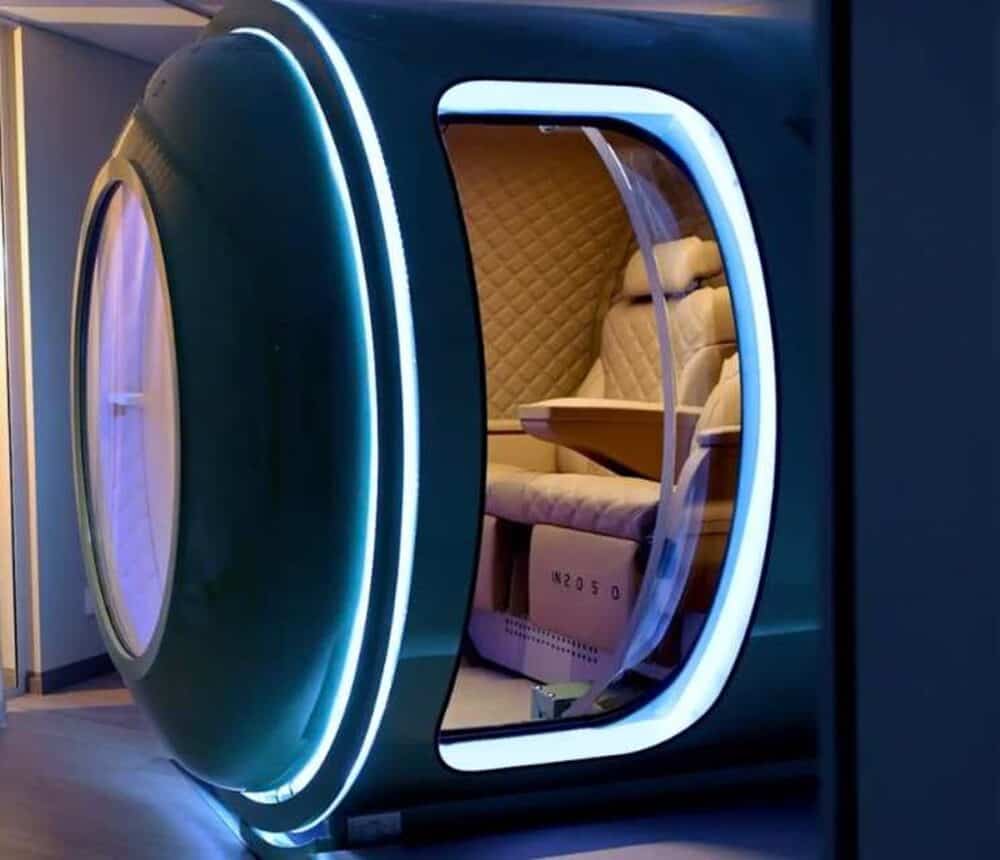
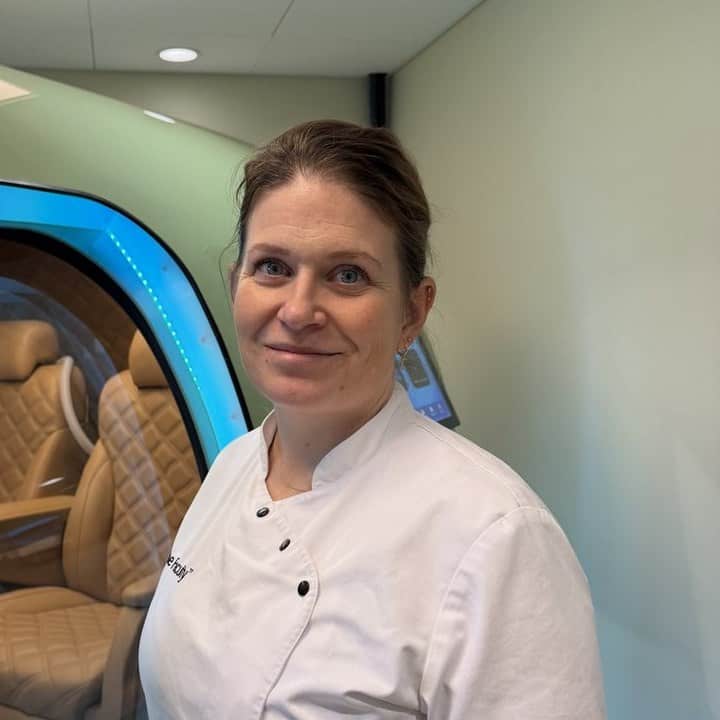
The film shows the chamber and the armchair you are sitting in, on Hangövägen.
Once you have booked, we will call you at a time that suits you. We will review your health declaration, your health and your medications, and if there is anything that makes you wait or refrain, see risks and side effectsThe conversation is mandatory before the first session, but you do not have to come into the clinic for it.
No perfumes, creams, makeup or electronics in the chamber. Oxygen makes it easier to start a fire if a spark forms, so the rules are strict in all chambers, not just ours. 3, 24 You change into cotton clothes.
Over a period of five to ten minutes, the pressure is increased to 2.0 ATA. You feel it in your ears, much like when an airplane is going down, and you equalize the pressure by swallowing or yawning. In the hospital, they usually say that you do this 20 to 30 times during the pressure increase. 3, 4 If you feel pain, we will stop and reduce the pressure.
At full pressure, you breathe oxygen through the mask for 60 or 90 minutes. Most people rest, read or sleep.
The pressure drop takes a few minutes and is easier on the ears than the pressure increase.
You feel normal and can drive and go back to work. Some people feel tired after the session, and it goes away the same day.
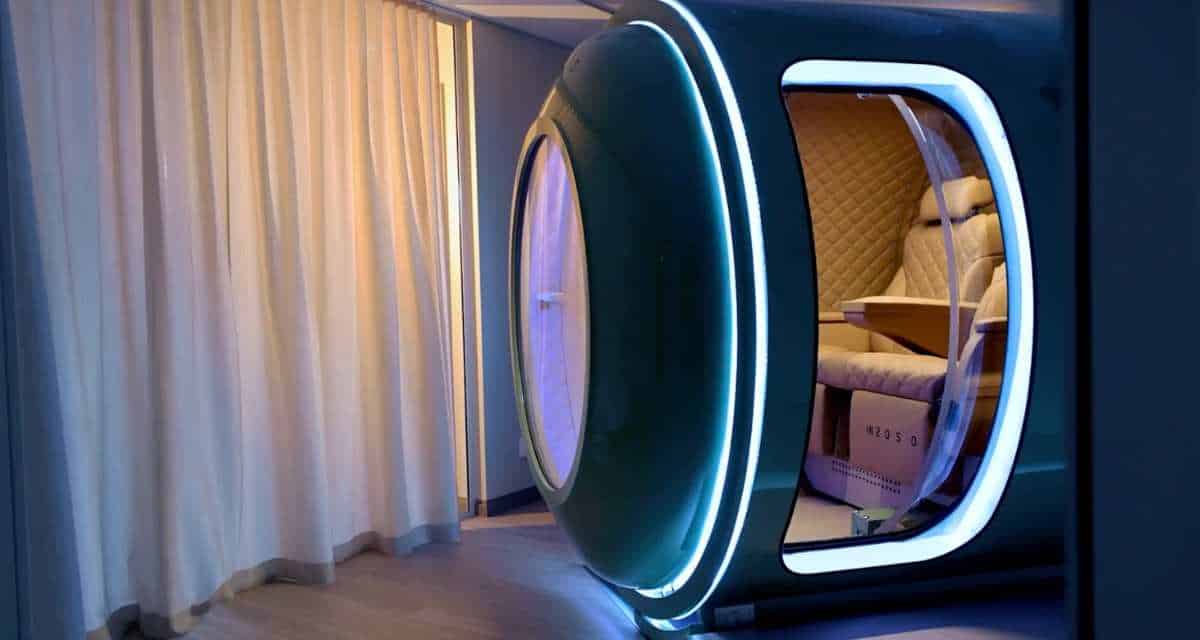
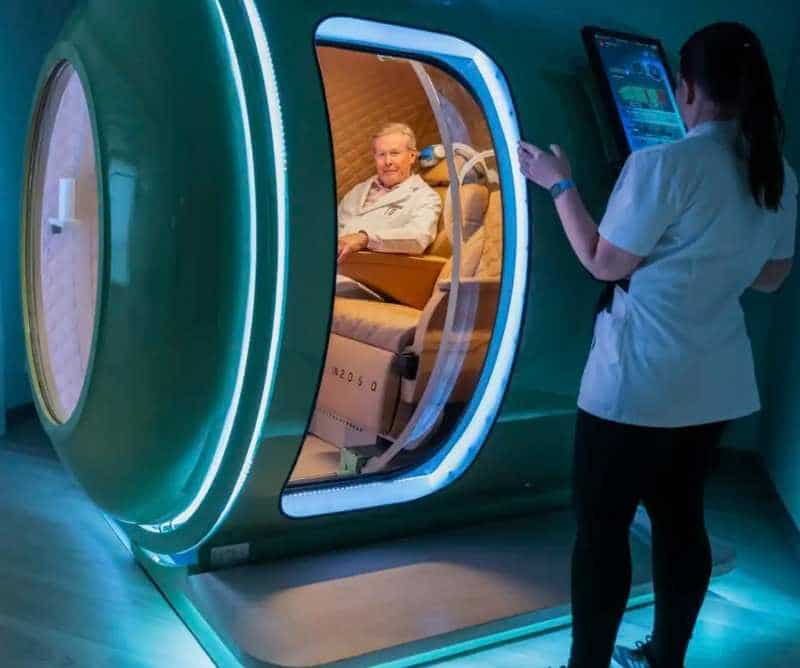
The chamber has a hard shell, is pressurized to 2.0 ATA and is located at our clinic at Hangövägen 20 in Frihamnen in Stockholm. If you want company, a guest can sit in the chamber with you during your session.
Steel and acrylic glass, the same type of construction as hospital chambers, in a smaller format.
You breathe the oxygen through a tight-fitting mask with a demand valve, so that the oxygen does not leak into the chamber.
The pressure is controlled from the panel outside, and the staff is watching you at all times.
The Swedish guideline summarizes: “Pressure equalization problems and claustrophobia sometimes constitute treatment obstacles, but otherwise HBO has a favorable side effect profile and is well tolerated by most patients.” 1 It's true with the big stuff: side effects are common but almost always mild, and serious ones are rare. Here's what they look like.
| Side effect | How common | According to |
|---|---|---|
| Pressure injury in the middle ear | 43 % of the patients in a series of almost 5,000 sessions, almost all so mild that treatment could continue | Heyboer 2017 21 |
| No side effects at all | 30 % in pressure chambers versus 10 percent in control groups, in randomized studies | Zhang 2023 23 |
| Oxygen convulsions | 1 in 2,000 to 40,000 treatments, more common at higher pressures than ours | Heyboer 2017, Hadanny 2016 21, 22 |
The numbers come from the hospitals' long series at higher pressures than ours. Your own risk depends on your health, pressure and number of sessions, and we will go over this before the first session.
The most common complaint is pressure or pain in the ears when the pressure is increased. In an American series of 236 patients, almost half had some form of pressure injury in the middle ear, but almost always so mild that treatment could continue. 21 If you have a cold or sinus congestion, it is not possible to equalize the pressure, and then we will wait with the exam.
After several weeks of daily treatment, some people become temporarily nearsighted. This is known from the long series in hospitals, often occurring after 20 to 30 sessions and returning within a few months. In very long series, over 150 treatments, cataracts can be accelerated. 21 With single sessions or short series, the risk is small.
In people with diabetes, blood sugar may drop during the workout, so eat before and bring something to measure with. Fatigue after the workout is common and harmless. 3, 21
High doses of oxygen can rarely trigger a seizure. In the largest materials, this occurs in between one case in 2,000 and one in 40,000 treatments, more common at higher pressures than ours. 21, 22 The attack ends when the mask is removed, and the staff is trained for this.
Oxygen does not burn itself, but it makes everything else burn more easily. Therefore, nothing that can give a spark or is easily flammable should be brought in: electronics, perfume, oil-based creams, makeup. In January 2025, a child died in a bedroom fire in Michigan, and in August of the same year, the US Food and Drug Administration (FDA) issued a fire safety reminder after several fires with fatalities. That is the risk the regulations are there for. 24, 29
Untreated pneumothorax, air in the pleura, is the only absolute obstacle. 1, 32 We also advise against or wait if you have a cold and sinus problems, lung disease such as COPD or asthma, severe heart failure, severe claustrophobia, uncontrolled epilepsy, recent eye or chest surgery, pacemaker or implanted defibrillator, and if you are being treated with certain chemotherapy drugs (bleomycin, cisplatin, doxorubicin) or with disulfiram. 1, 32 If you are pregnant, you cannot book a session with us. We never accept pregnant women, neither in the pressure chamber nor in any of our treatments. Always tell us what medications you are taking.
The word pressure chamber is used for three quite different things, and it is worth knowing which one you are talking about: the hospital chambers, which the regions run and which you access via referral, our chamber here at the clinic, and soft chambers that are sold for home use.
| Hospital pressure chambersRegional hospitals: Karolinska in Solna, Östra Hospital in Gothenburg, Helsingborg and Karlskrona. Public care, after referral. | With us Our pressure chamberThe Faculty, Hangövägen 20 in Frihamnen. Private, you book yourself. | Soft home chamberSold for home use, made of fabric or plastic. | |
|---|---|---|---|
| Pressure | 2.4 to 2.8 ATA | 2.0 ATA | 1.3 to 1.5 ATA |
| What you breathe | 100 percent medical oxygen via mask or hood 1, 4 | Oxygen, approximately 95 percent, via mask | Regular air, or oxygen from a concentrator 7, 9 |
| Shell | Steel, often multiple locations | Steel and acrylic glass | Fabric or plastic |
| Who is responsible? | Doctors trained in hyperbaric medicine, staff available 24/7 4, 25 | Experienced staff on site throughout the entire session | You yourself |
| Used for | Guidelines indications, after referral 1 | Voluntary passports, after health declaration and phone call | Marketed for well-being |
| What the specialist associations say | The basis of all evidence | UHMS specifies 1.9 to 3.0 ATA for treatment in healthcare. 6, 7 Our chamber is not classified as a medical device, and we do not provide those treatments. | UHMS: does not meet the requirements for any approved indication. ECHM and EUBS advise against marketing for "wellness" 7, 9 |
Our chamber is operated at 2.0 ATA, which is the manufacturer's recommendation. This keeps the risk of side effects low: more side effects are reported at pressures above 2.0 ATA. 22, 23 We do not perform hospital treatments. If you have a condition on the guideline list, you go to a hyperbaric chamber in a hospital via your doctor and referral, not to us.
A session in the pressure chamber with us in Stockholm costs from SEK 2,800 for 60 minutes and from SEK 3,500 for 90 minutes. If you buy a package, you get a 10 percent discount on five sessions and 15 percent on ten or twenty. The packages of twenty sessions include blood tests before and after the series. If you have company, that person can sit with you in the chamber for SEK 1,000. All prices are in the price list.
No treatments matched your search.
Try with a friend, 90 minutes Promotion until November 30 Two people, 90 minutes, for the price of one. Regular price 4,500 SEK.
3,500 SEKHyperbaric oxygen therapy in a pressure chamber — recovery, healing and longevity.
In a hyperbaric chamber you breathe oxygen under increased pressure, which allows more oxygen to dissolve in the blood and reach the tissues. A 60-minute session is the most common length if you want to try it.
A longer 90-minute session. The extra time is used by those who do HBOT regularly as part of a recovery routine.
If you bring company, that person can sit in the chamber during your session, at a lower price than a treatment of their own.
Ten 60-minute sessions at a 15 per cent discount. The most common choice if you want to do a continuous period.
Ten 90-minute sessions at a 15 per cent discount.
Twenty sessions at a 15 per cent discount. The package includes blood tests both before and after the course, so you can follow what the treatment does to your values.
Twenty longer sessions at a 15 per cent discount, including blood tests before and after the course.
Five 60-minute sessions at a 10 per cent discount. Purchased on site and the smallest package we offer.
Five 90-minute sessions at a 10 per cent discount.
Our pressure chamber is for those of you who are curious and want to try it, and who want to know what it does and doesn't do before you book. It is also for those of you who have had surgery with us and want to go into the chamber when the surgeon has given the go-ahead. It is not for those of you who have a condition where the healthcare system provides the treatment: then a referral is the right way. And it is not an alternative to care in the event of illness.
If you want to try a pressure chamber in Stockholm, book a single session of 60 minutes with us. Before the session, we will call you for a short review of your health declaration, so you do not need to come in in advance. If you have recently had surgery with us, your surgeon needs to give the go-ahead before the first session. Prices are available in price list, and if you have any questions about your health and the chamber, our staff will answer them before you book.
No, but a review before the first session is mandatory, and it is done by phone. Once you have booked, we will call you at a time that suits you, go through your health declaration and answer your questions. The first time you come to the clinic is for the session itself. Then another pass.
You sit or lie in a chamber where the air pressure is increased to about double, and breathe oxygen through a mask for 60 to 90 minutes. The pressure causes more oxygen to dissolve in the blood. Most people rest or read during this time. So goes another pass..
When the pressure is increased, the air in the middle ear and sinuses is compressed, which is why you feel it in your ears until the pressure has equalized. When you breathe oxygen under pressure, significantly more oxygen dissolves in the blood plasma, at 2.0 ATA over ten times as much as when you breathe regular air, and the dissolved oxygen reaches further into the tissue. This is the basis of treatment in healthcare. What this means for healthy people is less known. What is a pressure chamber?.
A session with us is 60 or 90 minutes at full pressure. There are also five to ten minutes when the pressure is raised and a few minutes when it is lowered. In healthcare, a session is usually 60 to 90 minutes. 1 So goes another pass..
In healthcare to get oxygen to tissues that are lacking oxygen: in cases of diving sickness, carbon monoxide poisoning, difficult-to-heal wounds, radiation injuries and endangered skin lamblia. Privately, passports are offered for recovery and well-being, and there the research is considerably thinner. What the pressure chamber is used for.
Yes. HBO stands for hyperbaric oxygen therapy, HBOT for hyperbaric oxygen therapy, and both mean oxygen under increased pressure in a pressure chamber. Healthcare usually writes HBO, private clinics HBOT. HBO treatment, HBOT treatment and pressure chamber treatment are therefore the same thing. What is a pressure chamber?
With us from 2,800 SEK for 60 minutes and 3,500 SEK for 90 minutes, with discounts on packages of five, ten or twenty sessions. Treatment for conditions that the healthcare system treats is paid for by the region after referral. All prices.
It depends on what you want to achieve. Healthcare provides series of 30 to 40 sessions for wounds and radiation injuries, and single sessions for acute conditions. 1, 11, 26 For healthy people, there is no study that says how many sessions give what results. The studies that have been done used 60 sessions. 18, 19 We recommend that you try a pass first. What does the research say?
You fill out a health declaration, and before the first session we will call you and go through it. Come without perfume, creams and makeup, and leave electronics outside the chamber. Oxygen makes it easier to start a fire if a spark is formed, so the rules are strict in all chambers. 3, 24 Once there, you will change into cotton clothes. So goes another pass..
The pressure is felt in your ears as it increases, much like in a descending airplane, and you equalize the pressure by swallowing or yawning. At full pressure, most people don't feel anything special. The mask may feel heavy for the first few minutes. Afterwards, you feel normal, sometimes a little tired.
The most common is pressure or pain in the ears and sinuses. After long series, vision may temporarily become myopic. Rare side effects are seizures from the oxygen, about one in 2,000 to 40,000 treatments. 21, 22, 23 People with diabetes can get low blood sugar. Risks and side effects.
With a health declaration, trained personnel and the right pressure, serious side effects are rare. The risk that requires the most discipline is fire, as oxygen makes everything burn more easily, and therefore no electronics, perfume or cream should be brought in. If you have untreated air in the pleura, lung disease or severe heart failure, you should not go into a pressure chamber. 1, 32 Who should give up?.
The chamber is CE marked as a pressure vessel according to the EU Pressure Vessel Directive, not as a medical device. It is designed according to ASME PVHO-1, the international standard for pressure vessels occupied by humans, and inspected by a notified body. The masks are tight-fitting and have demand valves that only release oxygen when you breathe in, so that oxygen does not leak into the chamber and the risk of fire is kept low. Experienced personnel who are trained in safety and in operating the chamber are on site throughout the session. The session is not a treatment for any disease. Risks and side effects.
The benefits of hyperbaric chambers depend on who asks. For the conditions that are in the healthcare guidelines, there is support, with varying degrees of strength in the evidence. For healthy people, there are no studies that show that it provides better health, longer life or faster recovery from exercise. 18, 19, 20 Some people feel more energetic after a session. We're not saying more than that. Longevity and recovery.
When a skin graft or flap is threatened by oxygen deprivation, it is a recognized treatment that the surgeon refers to in hospital. For regular healing after aesthetic surgery, the evidence is thin: one retrospective study on abdominoplasty with fewer complications, two very small studies on facelifts, and reviews calling for better studies. 14, 15, 16 With us, you can book sessions after surgery when the surgeon has given the go-ahead, but we do not offer them as treatment for healing. After an operation with us.
No one knows today. Small studies in healthy older people have shown better results on cognitive tests, better oxygen uptake and changes in blood tests, but without placebo and without long-term follow-up. 18, 19, 35 Researchers in hyperbaric medicine warn that the treatment is being marketed as if it were proven. 9, 27 Longevity and recovery.
It is unclear. In an Israeli placebo-controlled study, 40 sessions resulted in better cognitive function and more energy, while ten sessions in the Swedish randomized study from Karolinska yielded no more than placebo after 13 weeks. 17, 33 The Swedish guideline has post-covid under surveillance: not recommended in regular healthcare. 1 We do not offer passports as a treatment for post-covid. What does the research say?
At our place at Hangövägen 20 in Frihamnen in Stockholm, where you can try HBOT in a hard shell chamber with trained staff on site. The sessions with us are not a treatment for any disease. Do you need treatment for a condition in the healthcare guidelines there is Karolinska University Hospital's pressure chamber in Solna, where you can get to via referral. 4
No. The wellness allowance applies to simple exercise and stress-relieving treatments, not healthcare, and this includes treatment in a hyperbaric chamber. 28
Yes. You will feel normal afterwards. If you feel tired, wait a while before driving.
Pregnant: not with us. We never accept pregnant women, neither in the pressure chamber nor in any of our treatments. Cold or stuffy: wait until you can equalize the pressure. Diabetes: yes, but eat before the session and bring something to measure your blood sugar with. Who should give up?.
It is possible, but home chambers made of cloth or plastic operate at 1.3 to 1.5 ATA, often with regular air. Specialist associations say they do not reach the pressure and oxygen content required for any approved treatment, and advise against marketing them for wellness purposes. 7, 9 Hospital, clinic or home room.
Yes. Medical oxygen is approved as a medicine by the Medical Products Agency, and according to the product information, hyperbaric treatment should be given by qualified healthcare professionals. 5 That's why we have a health declaration and a review before the first session.
The Evolution Of You, Guided by Science