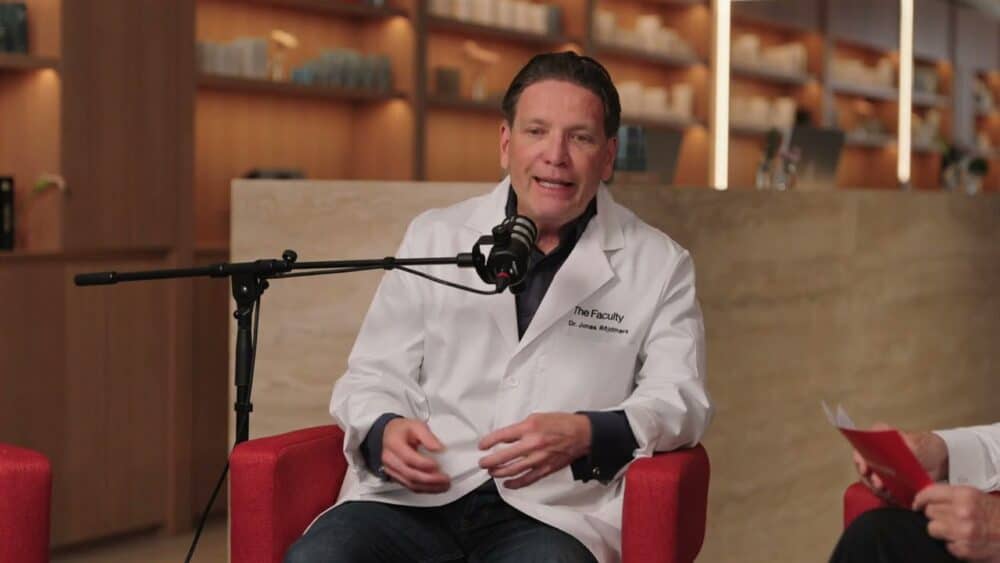
Intimate surgery – What treatments does the term ‘intimate surgery’ cover?
Per Hedén and Riikka Veltheim explain exactly what intimate surgery entails: birth-related injuries, labia reduction, fat grafting and male intimate surgery.
Watch on YouTube

Related treatments: Intimate surgery in Stockholm
Do you just want to listen?Play the episode as an audio file – the text below will still be displayed.
Chapter
Transcription
Click on a time to jump to that point in the video. The text will follow as the section plays.
00:02 Welcome to The Faculty podcast. Plastic surgery, cosmetic treatments, beauty ideals. A multi-billion industry that everyone has an opinion on but few really understand. Here, we peel back the façade and delve straight into the reality behind one of the world’s most talked-about and controversial industries. In today’s episode, we’re talking about something that’s rarely discussed openly: intimate surgery.
00:29 What treatments does the term ‘intimate surgery’ actually cover? What is a birth injury, and how does a penile lengthening procedure actually work? Together with Associate Professor Per Hedén and Dr Riikka Veltheim, we clear up common misconceptions. We’ll answer the questions we’re most frequently asked and take a closer look at how intimate surgery actually works. This is The Faculty podcast.
00:55 To answer questions about intimate surgery, I’ve brought along Riikka Veltheim, who’s sitting here to my right. She’s a passionate plastic surgeon too, but she also has a particular passion for intimate surgery. I don’t perform intimate surgery myself. I’ve limited myself to performing perhaps a few labia procedures these days on patients who are having a facelift anyway, and so on. But you have a great deal of experience in this area, and I’m a bit curious as to why you, as a plastic surgeon, Riikka, have specialised in this field
01:42 in this particular field of surgery. Yes, but I’ve been working in plastic surgery for 25 years and, like most of us at The Faculty, I started my career at the hospital. And there, we were usually involved in areas relating to intimate surgery, where a person is uncomfortable with their assigned sex at birth and undergoes major surgery. And then, for the last 20 years, I’ve been in the private sector, working both in aesthetic genital surgery and, to a large extent, in reconstructive surgery, which deals with injuries following childbirth or...
02:29 Something that changes as we get older. And in that regard, I also carry out a great deal of other plastic surgery. But if I had to pick one category of plastic surgery where most people are satisfied or extremely satisfied, I would choose this one. In my view, based on my experience, I feel that it can enhance quality of life to the very highest degree.
02:58 Mm. And that actually applies to both men and women, doesn’t it? It certainly does. Exactly. It’s a very intimate part of our lives, but also very much part of everyday life. Something that affects us almost every day. And it changes – either because you’re born with something you’re not happy with, or because life gradually changes us. And life today is long, thank goodness, and hopefully a very active one at that. We’re living longer, we’re active, we’re social.
03:32 Often, the fact that life is so long means that we may not always spend our whole lives with the same partner. And, as life goes on, this also raises questions about whether and when I might want to change or improve things in areas where the line between what is medically justified and what is purely aesthetic is concerned – just how clear is that line?
04:05 It isn’t all that obvious because it’s an area that’s very functional. So, of course, there are certain cases that are purely aesthetic, but perhaps one of the myths out there is that it’s all just about how you look. On the contrary, in fact, most – and indeed the vast majority – of the patients I meet in my day-to-day work as a plastic surgeon have some sort of functional problem.
04:43 Either an injury, as I mentioned, following childbirth, or something that has changed over the course of one’s life and causes physical discomfort. Mm. And as for the functional problems, if we focus on women, then that’s related to the fact that you do experience a change after giving birth, doesn’t it? Yes, usually.
05:14 And this is, of course, regarded as the norm within the public healthcare system. It’s done in Sweden. Then, of course, different countries have different practices. This is also very much culturally determined and varies greatly. If you look at Sweden and Scandinavia in general, there is a sort of old-fashioned idea that when a woman gives birth or is pregnant, that is – well, it’s very natural and normal. That’s what we’re meant to do, but when you suffer an injury as a result of this natural process – childbirth and pregnancy – I don’t think it should be something that
06:01 cannot and should not be remedied. Because, as I mentioned earlier, life is long. If you think of a young woman today who is between 25 and 35 years old – the age at which most people have children – then you are very young and may well live for at least another 100 years. And if you’ve suffered an injury that affects your life almost every day, then it’s crystal clear that you should have it treated if you can. And today in Scandinavia, this isn’t covered by the public healthcare system; you have to seek private treatment, and not everyone has that option. In contrast, however, in countries such as – often Arab countries –
06:48 Or in countries where healthcare is largely covered by private insurance, such as Switzerland, these matters are automatically dealt with within the private insurance system and within the maternity care sector. And that’s the thing: in Sweden, you don’t receive this sort of help unless you have, for example, a very severe tear in the vagina.
07:16 Exactly. Precisely. Precisely. So what’s referred to as quality of life – having a normal sex life even after you’ve given birth – isn’t considered a strong enough reason in itself to seek help through this operation; rather, it’s more a case of it being normal to have given birth. But if you think about it every day, and it’s not just your sex life that’s affected, because the vaginal muscle is a sort of—I usually explain it as being like a funnel. It supports other organs in our body. It supports the bowel, it supports the bladder, and it supports the womb. And when that support is lost, other side effects occur.
08:07 which has a negative impact on a woman’s life. And if it is highly functional, then it is classified as a public health condition. If it is highly functional. But that does, of course, require that the damage be very, very serious – such as damage to the bowel and the like – which makes it necessary to keep it under control. How does it work? How does the procedure work, technically speaking, when this is treated?
08:37 regarding the vagina, or when the vaginal muscles are affected. They are, after all, always affected in a woman who has given birth. Even those who give birth by caesarean section may experience some stretching of the muscles, due to hormonal changes and the pressure of pregnancy. But particularly when the baby is born naturally via vaginal delivery, changes occur in this ring-shaped muscle. It either stretches or it tears. And it can tear partially or it can tear completely. But all women – almost all women who give birth this way – experience a difference. It
09:23 It doesn’t always cause problems, but when it does, this damage can be repaired using a procedure known as colporrhaphy, or vaginal narrowing surgery – an operation we carry out regularly at The Faculty. And what exactly is removed – just the mucous membrane? A section of the mucous membrane is removed to access this muscle, which has become stretched, and then that muscle is lifted up; between the vaginal opening and that area there is, normally when we are young, a thick layer of muscle. A really strong layer of muscle, which then gradually becomes thinner and thinner with each childbirth. And that
10:11 It’s what you’re rebuilding. So it does provide support. Aesthetically speaking, it’ll look better in the vast majority of cases, but above all, it’s this function and the support it provides upwards, where you can feel that you’ve regained the ability to run without leaking urine, or to jump on the tennis court, or to play with the children – as many women who are medically termed ‘incontinent’ experience exactly this kind of urine leakage.
10:44 Yes. And it can also be caused by other factors, which is why it’s a complicated matter. You can’t always promise a specific effect or result. But in the vast majority of cases, when you regain that muscle tone or support, you feel supported, which in turn leads to a different kind of sex life. That’s what most people experience. Yes, you remember when you were a medical student and had to suture a tear in the vaginal opening. And back then, according to the midwives I was assisting, it was important to repair the muscle
11:32 Also, not just the mucous membrane. Exactly. Exactly. Exactly. But there are now so many different techniques and such a wide range of approaches in this type of surgery that you can do whatever is needed – though, unfortunately, in most of the cases I see in our department, they’ve probably done something similar to what you had to help with as a junior doctor. Not quite as comprehensive or helpful. They can offer some benefit, but they don’t really provide the same level of support as the technique we use, where we actually repair the muscle much more deeply and provide a completely different level of support. And as for the problems the patients experience, it’s more or less a loss of sensation in their lower abdomen, or whatever, how…
12:23 Is that how they put it? No, but exactly – you feel big. You might notice that water collects when you’re in the bath. You might feel that you don’t really have control over your sex life because you don’t have the same muscle structure. You might feel, just as I mentioned in relation to sporting activities, that you’re not quite as tight. There are so many details that you notice. Many people don’t really know what’s happened, but you feel a clear difference for the worse, and then you often start wondering what you can do about it; and unfortunately, it’s not at all unusual to have seen a midwife or been to a gynaecologist who
13:11 I think it’s perfectly normal, even if you have all these problems. Mm. So, I do think that’s a shame, but I think it’s fantastic to be able to help, and for most people – even though, as I mentioned, I carry out many other procedures, such as breast augmentation or perhaps something else – performing this operation over all the years I’ve been working in this type of reconstructive surgery, that’s what gives me this fantastic feeling. Now I’ve got my life and my quality of life back. Mm.
13:49 Yes. No, but I’ve certainly come across patients who’ve had this operation and who feel they’re enjoying their sex life more. Mm. Exactly. And I suppose you’ve found that too. Yes, exactly. Exactly. That’s definitely one of the key aspects. It’s the sex life and being able to carry on living a normal life with your partner – or, in many cases, perhaps you’ve got divorced and feel that now you want to move on with your life, which, unfortunately, is often the case these days as we live so long. And then you feel, ‘Now I want to do something about this, because I…’
14:37 I’ve been thinking about it for a long time – ever since my youngest child was born. How do you discuss the risks and uncertainties associated with this procedure? What do you tell your patients before they undergo an operation like this? No, but as with all surgery, every procedure we perform carries certain risks, so it’s important to go through them. But especially with an operation like this, which is a bit more extensive, it’s important to be well-informed. What’s the healing process like? What do I need to bear in mind? What I’m allowed to do and not allowed to do to ensure this muscle heals properly. And relatively speaking, it’s still only a short period of time that you have to abstain from
15:26 sex life, penetrative sex, sporting life. And if you do physical work, because that enables you to achieve something which then enhances your quality of life in many ways and for the long term. But what do you say about the healing process? What’s the timeframe? What’s your view on that? Well, the mucous membrane heals quite quickly. It’s a bit like the mouth or something similar – within a couple of weeks it’s usually well on the way to healing. But this particular muscle that’s been lifted up takes longer to stabilise. It’s a bit like when we suction the muscle after a tummy tuck or after pregnancy – it takes eight to 12 weeks to become fully stable. And there are, of course, slight variations depending on the case.
16:11 What you can do after a month is go back to your usual walks. After two months, I usually think you should start with light gym workouts, and then it’s 12 weeks – three months – before resuming penetrative vaginal sex. So you need to do a bit of planning for yourself and with your partner to ensure this heals properly, and then you can get back to your normal life. Perhaps the most important thing is to come to terms with the fact that you can’t expect to go back to how things were before pregnancy and childbirth, or to how you were when you were younger. And many women don’t feel they want to, or think there’s any point in doing so. But if you have someone who’s had plastic surgery, a role model or
17:03 If you have any specific requests, that’s not something we can promise. We can promise improvements in the vast, vast majority of cases. We need to be realistic about what we can achieve with this surgery. After all, the body has changed. We’re perhaps 10 years older than we were before our first child. The tissues behave differently than they did when we were younger – it’s part of the ageing process. Yes. In that area too, of course. Exactly.
17:32 If you look at the vulva from the outside, the labia – both the inner and outer ones – are they just for aesthetic reasons for patients, or are there functional aspects associated with them? Yes, but the labia are there to keep the vaginal opening warm and moist, so they do have a function; however, when they’re a bit too long – or ageing, pregnancy or other factors cause them to stretch – it’s possible to improve the appearance and make them a little smaller.
18:14 Or, in some cases, you’re born with something that’s longer than necessary. In that case, you can trim it a little and remove some of the so-called excess skin, which can even cause physical discomfort for young women, as it can get caught on jeans or knickers, or when riding a horse or a bike. And it’s quite common for a labia to be a little longer than necessary for normal function. I remember a patient I had many years ago; she was only 13 years old, and of course people say things like that, but can you perform plastic surgery on a 13-year-old?
19:03 But then you have to remember that even within the public healthcare system, children undergo surgery for protruding ears, and nobody has any objections to that. But if a 16-year-old were to have breast augmentation because they’re completely flat, or – as in this case – a 13-year-old were to have labia reduction, then people do take issue with it. But in this particular case, it was a mother who brought her daughter in, and she was very sensible – both the daughter and the mother. And she had inner labia that were this long. It looked like a small penis.
19:39 Mm. And the fact that her mum came along then – that was, of course, because this girl had refused to go to PE at school. Mm. Absolutely. That’s right. And just a very minor intervention meant she went back to PE at school. Then she came to see me as a mum. She was about 25 years old with two children.
20:05 Mm. And so I looked for something else. But you can see that plastic surgery can achieve a great deal if you’re truly willing to listen to the patients’ suffering and so on, rather than saying no – you shouldn’t do that to such a young woman. Mm. No, but exactly – in that case, it’s so vastly different from all the others.
20:33 So, of course, if you want to improve things, that’s an option. And that’s why this particular group tends to consist of women who haven’t given birth, who feel, ‘I find this difficult; I don’t want to show myself off.’ And it can even have a negative impact on their sex life. Because if the labia are so long, it can be something that gets caught, pulls, or draws far too much attention to something when you should be focusing on something completely different that enhances your quality of life. So it’s also important to get it right – to use the right surgical techniques or to see a surgeon who’s skilled in this area and takes the anatomy into account and
21:22 Safety, bearing in mind those areas… Well, you might think it’s just a matter of trimming away the excess, but it’s not quite that simple, especially when you consider that the labia also surround the clitoris. Mm. Absolutely. And the areas down there are all very different too. What I usually start by saying in my consultations is that we’re all different down there as well, which means there’s no right or wrong. So we can’t jump straight from one thing to another. We can only improve on our own starting point.
22:07 Mm. So that’s an important first step. And then the recovery process following a labia reduction. You know, there are no stitches to remove because they use absorbable sutures that dissolve on their own. Yes. So what do you say about the recovery period? Is it the same for labiaplasty as for vaginal plastic surgery? No, this is a much smaller operation, as you’re really just removing a small amount of excess skin. But of course, it’s in an area that’s very mobile. You’ll be moving about, so it’s still important to take it easy physically at first, especially during the first week. Because
22:56 Any movement pulls on these stitches, and if they’re pulled too much, gaps can form, which means the wound won’t heal as well. So take it easy at first, and rinse the area to keep it clean. If the healing gets off to a good start, it will heal relatively quickly within a couple of weeks. Yes, the outer labia. Mm. And they’re the ones that tend to change the most with ageing and perhaps due to multiple pregnancies – the weight of the baby and blood circulation cause the skin to take on a different shape, which many women notice after giving birth. The more
23:44 The number of births, the number of pregnancies, plus age. So this area actually changes for all of us, bearing in mind that we age very differently, but as we’re living so long these days – hopefully – it’s an area that many people are starting to think about. I don’t like this. It wasn’t like this before. And it’s a bit the same there. It’s actually stretched skin. It doesn’t serve much purpose at the length it might reach, so you can achieve a slightly more lifted appearance by tightening it, which most people feel improves their quality of life.
24:29 And then, of course, it’s also the case that fat grafting technology has advanced enormously within the field of plastic surgery. Absolutely. And I remember when we started performing fat grafts – it was back in the 1980s, I think – when an American called Coleman popularised the technique. Fat grafting had been carried out for a very long time before that, but there was an explosion of interest in the procedure. And since then, the techniques have advanced enormously. We do microfat, macrofat, nanofat and so on; we process the fat, and we know much more about what enables the fat to survive or not. So when you transfer
25:20 When transferring fat from one part of the body to another, it is important to ensure that the procedure is carried out correctly, that the fat is harvested properly, and that no excess blood or fluid is included in the fat being transplanted. So how often do you perform fat grafts to the outer labia? It’s common, but not quite as common as reducing the volume. However, if there isn’t much sagging, this skin does become a bit looser and more wrinkled as a result of ageing. And then it becomes an aesthetic issue where many people might wonder, ‘What’s happened there?’ And then, using this own fat, even if you
26:07 Don’t fill it in too much, as we don’t want the outer labia to become saggy and large. But what the fat contains, it contains what are known as growth factors – as you know, Per – which repair and moisturise the tissue, giving it a different level of firmness and volume, making it look younger. So fat can be used there, but more than just for the outer labia, it’s inin intimate surgery that we use fat grafting, and when it comes to the outer labia, I think the listeners are interested in that. How does it work? When you treat the inner labia, you can probably see that you’re trimming them, and that’s easy to understand. But when you
26:56 When it comes to the outer labia, how do you plan the surgical procedure, where do you make the incision, and so on? I imagine that’s what the listeners want to know. Yes. And as for the outer labia, I try to make the incision in a concealed spot because the skin there is different from the inner labia, which has a mucous membrane. When you operate on that area, the scar is usually almost invisible. I can spot it because I know what it is, but no one else would. On the other hand, the outer labia have quite thick skin, and if the incision is made just a little too visibly, it can look like a line, and then it can become a scar, which many women today
27:42 I prefer either to have all the hair removed using laser technology, or to shave; in which case the scar may be visible, so it’s important to position it slightly inwards to try and hide it, so that the inner labia are both positioned slightly inwardsof the outer labia. But one important point to note is that, as we have hair in that area – unless it has been removed by laser – you may feel that the hair moves slightly when we perform a facelift on men, and this does alter the position of the hair. Little things like this – if you’re well informed, you can usually accept it, or you can opt for laser treatment.
28:30 Hair removal. But you might find yourself thinking, ‘No, I don’t want any hair down there.’ In that case, you’d need to see a skin therapist who can remove the hair – and isn’t treating the outer fold of the labia a technique that can be used? Well, I haven’t seen or experienced that myself, at least – it’s usually done further inwards, given that you don’t want any tightening or scarring that would be near the groin or in that area, because that would cause discomfort during the healing process anyway. You want to know more about where the scar is and will be. Yes, hair removal is, of course, something that also affects the intimate area.
29:18 And that’s where developments have really taken off, and down at our clinic in town – The Faculty, the injection clinic as we call it – we have one of the very most modern lasers for hair removal, which is also virtually pain-free, though perhaps not quite so pain-free in this particular area. I don’t know what your experience of it is. I mean, obviously it does hurt a bit, but if you’re motivated and want to go ahead with it, you usually do it in a few separate sessions. You don’t remove it all in one go. It works. You can also use a numbing cream. But in this particular intimate area, well…
30:07 There are so many aspects to it these days. It’s not just the inner or outer labia, but also laser treatments and hair removal. We’re talking about pigmentation and laser treatments for the vagina. So, even though, as you said, people don’t talk about it that much, there’s actually a great deal of demand for it from various angles. Mm. And let’s move on to men’s intimate surgery, as men sometimes seek treatment because they don’t want hair on the shaft of the penis, and in that case you can suggest they have this sort of hair removal. And then you usually
30:59 I’d recommend having several different treatment sessions, as hair goes through different growth phases. Yes, exactly. And because it’s a bit uncomfortable and can prickle and hurt, you have a short session and then carry on. So I think that’s the most common approach. Mm. So what about—or rather, when it comes to men, have you seen a very clear increase in demand for intimate surgery? Absolutely, and it’s clear that the main reason is those who, unfortunately, are naturally smaller than
31:47 the standard volume, and that can, of course, become – or often does become – a psychological problem. But then there’s this large group who are seeking quality of life and who are, in fact, relatively normal. They simply want a better quality of life, or to look a bit fuller, or to have their hair lengthened or removed. So, actually, the larger category today is those seeking a better quality of life. Mm.
32:25 I’d like to see a bit of… you’re seeing increased demand from men. Absolutely. It’s become an increasingly common part of our plastic surgery practice – intimate procedures. What do you think is the reason for that, then? Well, perhaps in big cities, at least, it’s that many people have the opportunity to invest in themselves. I don’t think people gave it much thought in the past; they just lived their lives with those thoughts and had to accept it. Today we know that there are possibilities, both technically and, perhaps, financially, and people want to
33:11 and it’s becoming more accepted to invest in yourself. Then there’s also the fact that we’re living longer and we don’t always stay with the same partner for the rest of our lives. It’s not as if you’re married for 60 years and live in the same house on the same street. Life changes – for better and for worse. But then it can happen that things you’d previously planned become relevant again, and you want to make changes. I remember I wrote the book on plastic surgery – or *Plastic Surgery New*, as it was called in English – and that was quite a while ago.
33:49 But back then, when we carried out a few operations for that book on penile lengthening, there was certainly a demand for a longer penis, and we’ll talk about that too. But back then, it wasn’t about sexual function; rather, people said it was more about the ‘changing room’ aspect – showing oneself to other men. Yes. Yes,
34:34 which is one of the reasons for this, because the penis doesn’t extend as much during an erection as it does when flaccid, I suppose. That’s right, and it’s very important information; many people searching for this are quite well-informed, as they usually do their research at home first, and these days there’s a great deal of both good and bad information on the internet. But the advice I always give is that it’s when you’re standing in the shower or standing naked in front of your partner without an erection. That’s when it usually looks a bit firmer and better. Then, when you have an erection, we can’t promise or measure it in the same way. So it’s more a case of
35:24 The relaxed atmosphere in the shower when you’re playing tennis, or in a changing room. Yes. But also when you meet your potential future partner. I recently had a young man who felt that things just weren’t working out any more. He had no erectile problems, which is also a very important issue, and it’s clear that we can’t influence those things. We can only influence the aesthetic appearance and prescribe Viagra.
36:01 Yes, that’s an option we have. But, but, but, just the very fact of undressing and meeting someone naked for the first time is stressful, and that stress alone can affect how everything works. Mm. How do you perform a penile lengthening procedure? The penis has various ligaments, after all. There are two ligaments on the sides that keep it as straight as possible. None are completely straight, of course. And then there’s a ligament at the very top.
36:33 And you can, of course, release those ligaments – simply cut them, sever them from the pubic bone. Yes, exactly. That bone you can feel above the penis – the pubic bone – and there, too, are ligaments attached to the penis; in fact, there are far more than we can see. It’s an organ that extends deep into the body, after all.
36:59 And that’s what we’ve got. You’re born that way, so we can’t change that in today’s world; we can only highlight a little bit of what’s there, the part that’s visible. Yes, well, the thing is that almost two-thirds of it is hidden, but two-thirds of the penis’s length is inside the body. Exactly, and it’s only a third that sticks out – that’s the bit you can bring forward. Yes, that’s what you do with your leg.
37:30 Two isn’t quite right. You loosen this strip of connective tissue up towards the bone. You can loosen it – you can gain a few centimetres – and it’s also very individual, because we can only loosen this ligament to achieve an individual lengthening. We can’t say, ‘I want it like this’ or ‘I want it to be this length’. It doesn’t work like that in surgery. And that’s why we can help men. We can improve things for an individual to an indeterminate length. But usually, people feel that even those few centimetres you gain – most people feel – improve their quality of life. So you get something positive out of it. And
38:17 In some cases, people do both: they want more volume because, to the eye, it’s not just about length but also the volume of the male organ. And so, if you have a bit of fat somewhere on your body, you can use that to camouflage the base of the penis and add fullness there. And increasing that girth and volume also makes it look fuller or more substantial. So you can do either of these – how much of the transplanted fat do you say survives? It does survive, of course; we know that the amount varies greatly depending on the recipient site. And I usually tell
39:07 For example, in the eye area, the fat survives to a very high degree, compared with the lips, where survival rates are low. What do you say about fat survival in the penis? It’s a bit like a series of steps. Some fat survives; we know that. But we can’t guarantee the end result or measure it precisely; when we transfer fat – depending on what’s available – and then fill the area, that area isn’t infinitely stretchable either. So you can’t transfer large amounts; you transfer what’s biologically possible, and then perhaps 40 or 50 % remain. Which we see about six months later
39:54 surgery. Most people find that it has a positive effect. If you have fat, technically you can have it repositioned once more. And that means that the fat which was repositioned there the first time – as it is our own body tissue – receives a blood supply. And in the area that has gained blood supply, the fat that has now been transferred usually survives better. So, if you’re allowed to do it a second time, the result is usually not just as good, but even better.
40:27 Yes, but that does assume you have fat, doesn’t it? Yes, but I always say that fat grafting is one of the most common procedures we carry out in plastic surgery today. I perform fat grafts practically every day, and they’re mainly on the face. Mm. And it’s really been a fantastic addition to the technology we use.
40:55 But it’s important to do it properly – to process the fat correctly. It’s not just a matter of moving it. If you simply suction it out and move it, it won’t survive as well. But I always tell my patients that fat always survives. How much, however, depends on the technique used. But no plastic surgeon in the world can promise exactly how much will survive.
41:26 But you can always have another transplant. Yes, that’s important information. Exactly. But it requires another operation, a new recovery period, and usually further costs. So it’s obviously important to know this. It’s an option if you have enough fat. Then, of course, as we know today, some people are very conscious of the need to exercise, stay active and eat healthily. So many people are so fit and slim that they might not have much fat. You usually always have some fat. Usually. Not always, but usually. But being able to do it several times in the same area can be limited, and that’s where fillers offer the possibility of adding extra volume. Just as we women add a bit of volume to our lips or cheeks
42:16 So, it is possible to increase volume in the intimate areas, for both women and men, using fillers. However, this requires more than just a single treatment; the idea is that the filler, which is approved and gentle on the body, gradually dissipates. Mm. And one should be wary of using permanent fillers, as they are genuinely dangerous and not approved in Sweden. Thank goodness.
42:49 No, no, absolutely. Yes. This fat that’s being transplanted – at what level do you place it? You place it under the subcutaneous tissue. Mm. So that it acts more like camouflage, sort of. You fill in on top. You don’t go under the penis because that’s where the urethra is, and you want to leave that alone so as not to cause any physical damage – that would be unacceptable – and, of course, you avoid injecting into the corpora cavernosa, that is, the erectile tissues. Absolutely. That could be very dangerous.
43:29 It’s dangerous – just as you can experience if you inject too much fat into the gluteal muscle, it can actually lead to very serious consequences. There were, after all, cases in the US where they performed ‘butt lifts’ – Brazilian butt lifts – injecting large amounts of fat into the buttocks, which actually led to patients dying. Mm. Absolutely. No, that’s why it’s important to know what you’re doing and to use the correct techniques. That way, we can at least minimise the risks associated with surgery.
44:04 It’s also important to follow the aftercare instructions we give you. Look after your hygiene and come in for check-ups. All of that is important. It ensures we have a good recovery. Then we usually get a good outcome from a successful operation. Mm.
44:30 What are the most common questions you get about intimate surgery from women and from men? No, but very often there’s a fear that it might affect sensation, as these are very sensitive areas. And that applies to both men and women, and it’s very rare for that to happen. However, whenever you manipulate tissue and make incisions, you’re passing through various sensory nerves. So there are always theoretical risks. But if you look at a woman’s labia, for example – I usually tell my patients that if you have inner labia, and especially if they’re very long, they
45:19 doesn’t have much sensation. So that’s not where the sexual sensation is. Then, as a surgeon, you have to know what you’re allowed to do and what you’re not allowed to do, because there are areas – such as the clitoris – where you mustn’t even go near. In such cases, we get results that very, very, very rarely cause sensory problems. The same applies to men, though they might ask more about what length they can expect. If one could measure this final result – which one cannot. We only know that it’s somewhere between 2 and 4 cm.
46:04 the non-erect state, and then also how the male organ behaves when erect. And it’s important to know that when this ligament is cut to bring the penis forward, it creates a sensation of greater length. This can alter the angle of erection, so you may end up with a slightly lower angle of erection.
46:33 Not that it affects function, but it’s important to be aware of this and to be well-informed. So, exactly by how many degrees might one expect it to deteriorate? That it deteriorates. I don’t think there’s any specific study on that. It also depends on the patient’s age and their initial condition, and so on. And if you have underlying erectile dysfunction… Mm. Then I don’t think you should undergo male genital surgery. Mm. Because there’s so much psychology involved in the whole thing, and if you already have a problem, I don’t think you should
47:21 Performing surgery in that area could cause complications, even though the surgical technique itself has nothing to do with it. What have you come across as well, given that there is now a debate surrounding immigrant women who have undergone female genital mutilation? It may well involve treatment and public healthcare, but the practice of female genital mutilation is, of course, a contentious issue today.
47:57 Have you come across any such patients? I’ve met patients like that, unfortunately, and it’s always just as sad. Of course, the severity varies depending on the country where the procedure was carried out, and in those cases we don’t really have the technology in Sweden to help. There is, of course, a surgeon in Africa who won the Nobel Prize. I can’t remember his name at the moment, but I’ve always wanted to meet him and go and learn from him. But unfortunately, that country is in the midst of a war, and I would have put myself in danger, given that he has dedicated his life to these women who are injured in war and as a result of rape, and hasn’t held back.
48:44 that his life is in danger. He’s always had this passion for helping others. I’d like to meet him, Per, and when we have our annual BTS plastic surgery conference – which attracts people from all over the world and where you usually find fantastic speakers. Yes.
49:09 I’d like to hear what he has to say. But then there’s the other issue that’s highly controversial, which is hymenoplasty. In certain cultures, a woman is not supposed to have had sex before marriage. And that’s still the case in large parts of the world, even though we live in little Sweden where many people have no idea what life is like for women in other countries. But when those women move to Sweden, they often continue to live under those expectations. And there’s a surgical procedure – a relatively minor one that’s usually very helpful – but it was made illegal.
49:58 in France relatively recently – perhaps two or three years ago – and now that debate has also reached Scandinavia, which has led us to decide not to carry out these operations, even though, technically speaking, this may put the woman’s life at risk. And the reason for this, of course, is so that they experience a little bleeding on their wedding night.
50:27 Yes, exactly. Exactly. And as it’s a fairly minor procedure – a very minor one, with very low risks – and, in theory, it means this woman won’t miss out on her life. But it’s not a case of honour-based violence, is it? Yes. Mm. No, but you also mentioned the BTS congress. Mm.
50:55 Which takes place from 28 to 30 May. And this year marks the 24th anniversary of my founding this congress; this year we’re expecting perhaps 1,000 delegates to come to Stockholm, to the Stockholm Waterfront, and it’s been very inspiring to be able to showcase what plastic surgery can achieve in a country like Sweden. Of course, the faculty members I’m inviting come from all over the world. But still, it’s an honour that they want to come here.
51:41 Yes, it’s fantastic. And it’s not just surgery – there are injections, laser technology and, even today, longevity treatments, which you’ve introduced to Sweden to some extent. Mm. It’s fantastic. Yes. Yes, but it really does feel great. Mm. Is there anything else you’d like to say about intimate surgery now that we have our listeners with us? No, but that’s what most people find – that it improves their quality of life at different stages of life. So that’s how I feel about it – I love it. It’s fantastic to have that knowledge, and I’m passionate about it.
52:29 Yes, the thing about plastic surgery is that it has developed enormously over the years I’ve been practising it, and it’s expanded from microsurgery, craniofacial surgery and other procedures to intimate surgery and so on. There’s really been an explosion in the number of different types of procedures we carry out. And that’s what’s so fantastic about working in this speciality. So if you carry on listening to this podcast regularly, you’ll find out more about what we get up to in plastic surgery. I hope you’ve
53:16 I’ve really enjoyed this segment on intimate surgery. I’d like to thank you, Riikka, for sharing this knowledge with our listeners. It’s been such a pleasure to speak to you. Thank you.